What two-way hospitality can look like in churches
Geoff Moore looks at food, faith and fellowship, and how his church (and others) can encourage two-way hospitality.
Geoff delivered this sermon at St Brandon’s in Brancepeth, near Durham, on Church Action on Poverty Sunday.
Readings: Isaiah 35:3-6; Psalm 147:1-7; Luke 10:1-9
We’ve been supporting Church Action on Poverty (CAoP) for many years.
It’s not one of the charities we support on a regular basis from our general giving, but marking Church Action on Poverty Sunday regularly has given us the opportunity both to reflect on and support their work (more on that later), and also to reflect on our own attitudes and commitment to the eradication of poverty.
CAoP works with others to identify the causes of poverty and address them, and engages in social action (I’ll come back to one example of that), political engagement, prayer and theology. One of its key tenets is that the experts on poverty are those who are or have been in poverty, and so listening to their voices is absolutely key.
I think CAoP has moved its Sunday to this time of year because 17 October is the International Day for the Eradication of Poverty – so here we are on the Sunday closest to that. And note the ambition inherent in the International Day – the eradication of poverty not just its reduction.
And why not? Jesus’s comment that “the poor you will always have with you” (e.g. Matthew 26:11) should be taken only as an observation on the state of the world, not a conclusion that this will always and necessarily be the case. Much of Jesus’s teaching and action leads to the opposite conclusion, and we cannot seriously imagine the coming of the Kingdom of God involving poverty of any kind.
And we see something of this in two of our readings this morning. Isaiah speaks of restoration following judgement – the blind, the deaf, the lame, the dumb will all have their senses restored, and the natural world too will be renewed, with streams flowing in the desert.
Although it doesn’t mention people in poverty explicitly, here is a picture of things being put right, things as they were meant to be. And it’s not difficult to extend that to include those who are materially poor. And particularly so when that is precisely what our psalm says: “The Lord lifts up the poor”.
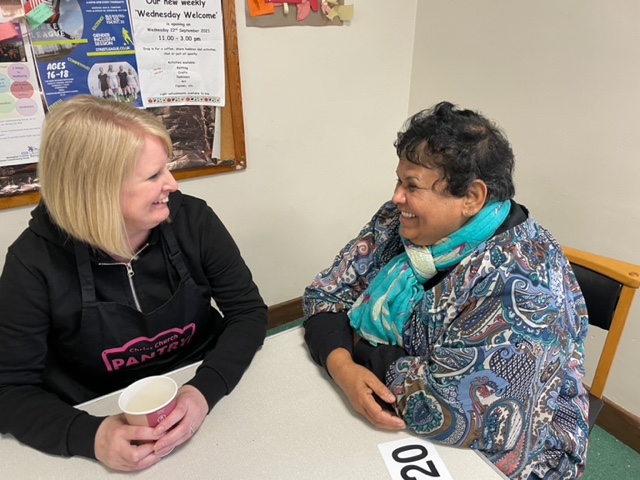
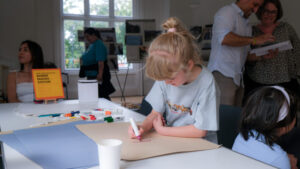
Pantries are places of friendship as well as food
How should we respond to that message of the Kingdom?
I was struck by a quote on the publicity for this year’s CAoP Sunday by a vicar from Dingle in Merseyside:
“Churches have to do this. Honestly, you have got to put people who are poor first, I think. We have been doing this for five years and people are coming all the time, and we find out a lot from people when they come.”
So, a real engagement with people who are in poverty, inviting them to come along, and clearly receiving from them as well as giving to them. And it’s clearly worked for them. I wonder what that might mean for us.
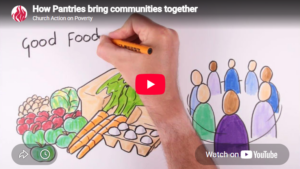
Perhaps one way of approaching that might link to the theme for this CAoP Sunday – “Food, faith and fellowship”. And note the order – food first! I think one of the reasons for choosing that as this year’s theme has to do with CAoP’s initiative called ‘Your Local Pantry’. They now have over 115 of these across the country, and the idea behind them is that they offer more than food banks.
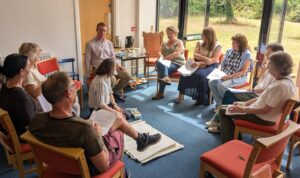
As well as food available at reduced prices, there are drop-in cafes, communal lunches, cookery classes and recipe swaps. And, as a result, friendships are formed. One member (and these are membership organisations) recalled: “I found friends, connected with people and it improved my mental health and sense of being included and belonging to a local community”.
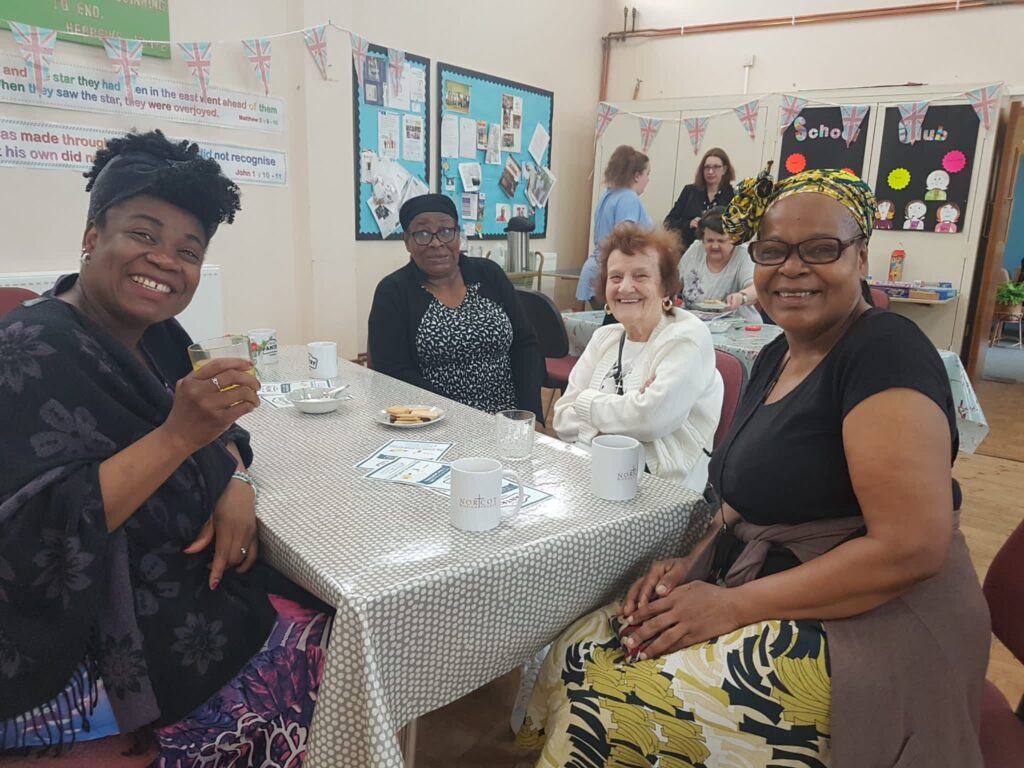
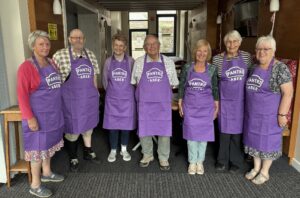
Pantry members enjoying a chat and a drink
One thing that’s interesting here is that these Local Pantries are not principally about giving food, but about sharing it. And that allows hospitality to flow in two directions not just one.
We see something like that going on in our Gospel passage this morning. It is, as we heard, from Luke so a good way to mark ‘Luke the Evangelist’ Sunday. And it is about evangelism – the seventy being sent out by Jesus in pairs ahead of Him to proclaim the Good News of peace and that the Kingdom of God has come near.
But, it’s not all oneway traffic. The seventy are told to eat and drink whatever is provided for them in the houses in which they’re invited to stay, and again to eat what is set before them.
And it probably doesn’t stretch the imagination too far to suggest that it was over these shared meals that conversations would have taken place, conversations about Jesus and all He had been doing, and who the disciples understood Him to be – for it was only in the previous chapter in Luke’s gospel that Peter had correctly identified Jesus as the Messiah.
Pantries are not principally about giving food, but about sharing it. And that allows hospitality to flow in two directions not just one.
Geoff Moore
So, the same question returns – what might all this mean for us both individually and collectively?
One thought here might be in relation to the congregational lunches we’ve started recently. These are excellent examples of ‘Food, faith and fellowship’ for us, as well as being fundraisers. But I wonder how we might develop that idea in a way that reaches out beyond us, and into the community around us.
One of the things that came out of the PMC process was a renewed openness to partnership with the community, something that has borne fruit (pun intended) in a number of ways. But, in a village that’s already well known for its food and hospitality, how might food play even more of a role in our partnerships?
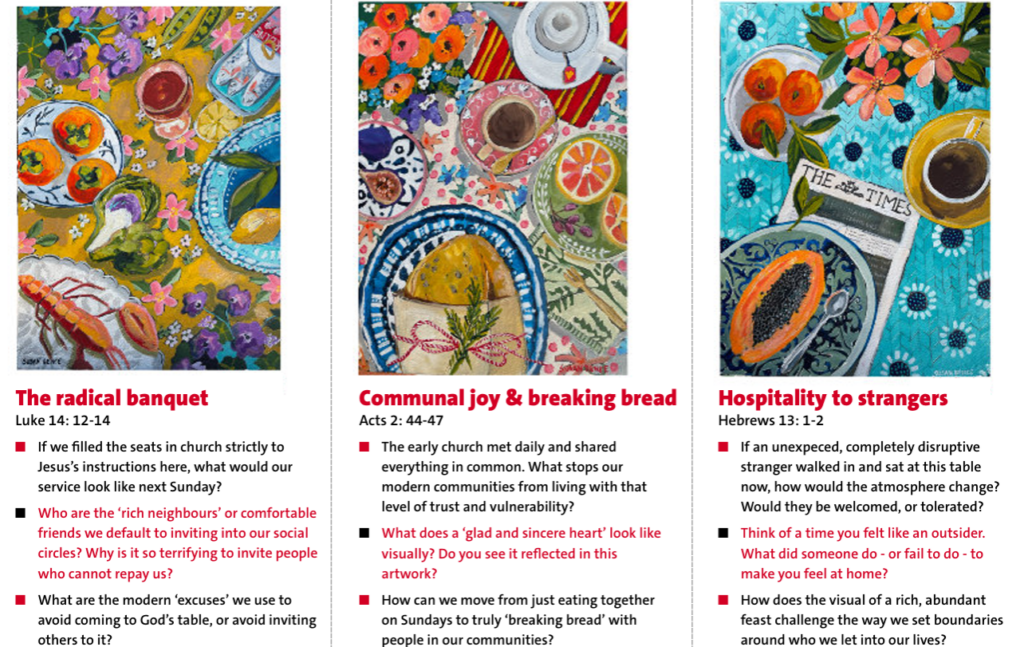
To help us think about this, CAoP has provided some resources. They’ve commissioned from one of their supporters three ‘tablescape’ paintings, reflecting the theme of food, faith and fellowship. Each is accompanied by a scripture reading, and 2 some conversation prompts. The themes are: The radical banquet, appropriately from Luke’s gospel; Communal joy & breaking bread from Acts; and Hospitality to strangers from Hebrews.
These three paintings, with the associated scripture reading and the starter questions are set out. So, the activity that forms the ‘Reflection’ part of our service, is to spend some time looking at one or more (maybe all three) of these paintings, and considering the scripture reading and starter questions.
And then talk to each other about what strikes you, what you think this might mean either for you or for the Church
Thank you to Geoff for allowing us to share his sermon