fbpx

Pantries reach 1 million visits – as new research proves they work

Community breakfast held to mark millionth visit

New research shows Pantries improve people’s health, reduce worries and reunite communities

Thank you for your amazing support!

Pantries now save members £27 per visit, with total savings of £6.9m a year across the UK

17 November 2025
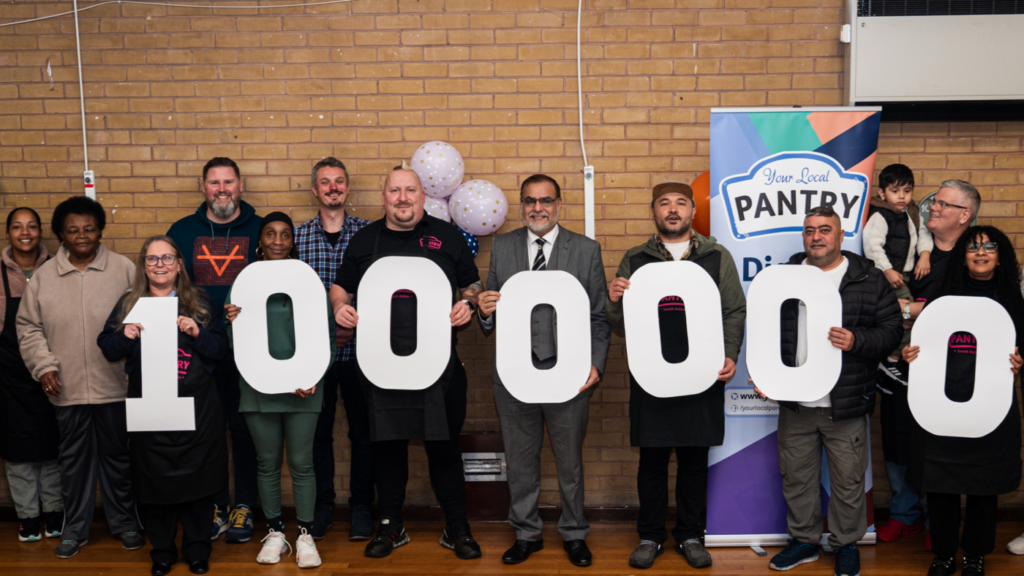
A line of people holding cardboard numbers reading 1,000,000

We’re thrilled today to announce that the Your Local Pantry network has reached its one millionth visit – at the same time as new findings show more clearly than ever that Pantries are successfully preventing people from falling into acute crisis.

We marked the milestone moment with a community breakfast event for members, supporters and friends in Birmingham, home to more Pantries than any other UK city. 

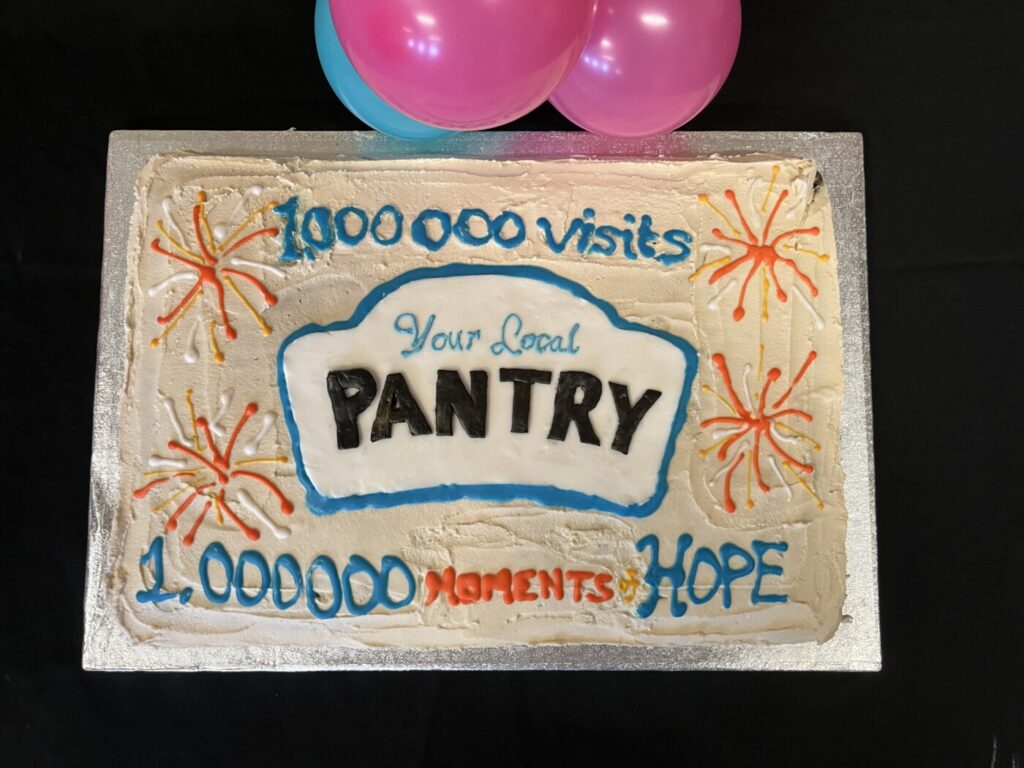
A million visits is an incredible milestone. It represents a million moments of real face-to-face community spirit in action – a million smiles, hellos, welcomes, greetings, shared laughs, comforting shoulders, and friendship and more. 

A large rectangular cake with the Your Local Pantry logo and "1,000,000 visits" written on top.
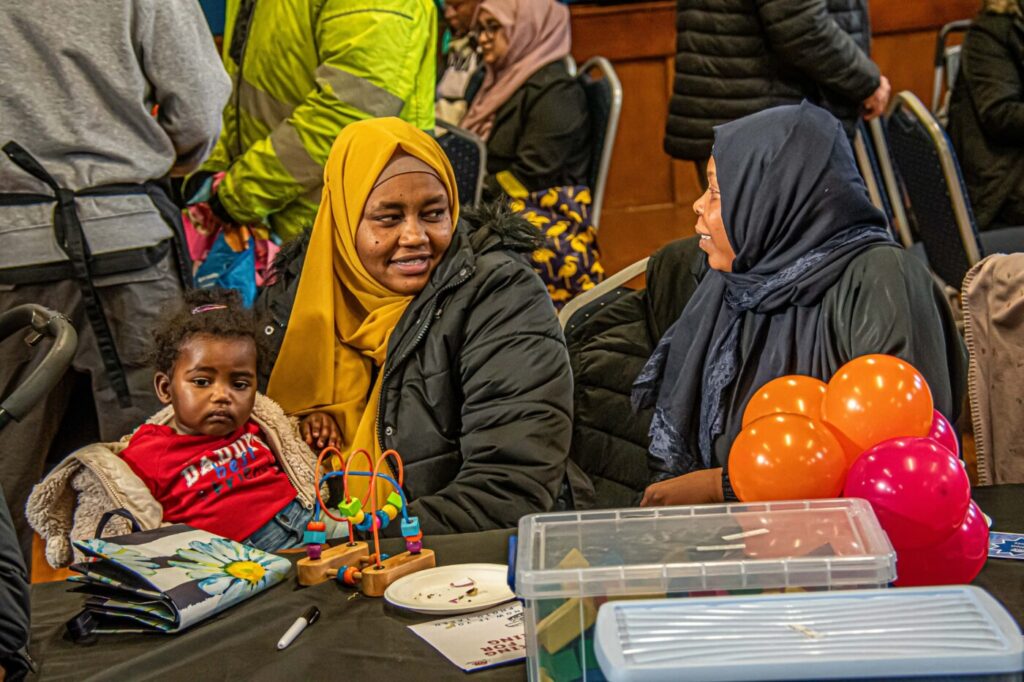
Two women and a toddler sitting chatting at a table

We’ve also completed new research into the financial value of Pantry membership. 

Members typically now save £27 each time they visit a Pantry, and over the past 12 months members across the country saved a total of £6.9 million!  

Pantries help people avoid crisis point

The millionth visit came at the same time as new research, showing that community food clubs such as Pantries are leading to a reduction in food bank usage and severe hunger.

Among Your Local Pantry members who had previously had to use a food bank, 71 per cent had been able to reduce or completely stop their food bank usage. Furthermore, 70 per cent of members who previously had to skip meals were doing so less often, since joining a Pantry or similar project.

One member said: 

“I have been able to eat meals instead of skipping them while my kids eat every meal. Before, I was skipping an evening meal every other day to make sure that there was food on the table for my children.”
Pantry member

This summer and autumn, Your Local Pantry and six similar organisations surveyed over 14,000 people who access membership-based food clubs. These projects typically operate at neighbourhood level, with local residents joining as members and accessing top-quality groceries in return for just a few pounds per visit.

Our survey found that as well as saving members money and helping them to avert crisis, Pantries are also bringing a range of social and health positives:

  • 82% of members surveyed said they feel more connected to their community
  • 97% say they’re more able to afford to eat balanced meals
  • 75% are eating more fresh fruit and vegetables
  • 83% say they feel less stressed or worried about running out of food

Pantries must be a big part of the solution

The surveys were coordinated by Feeding Britain and took place over summer 2025. An analysis of the combined results concluded that “food clubs represent one of the most promising place-based approaches to tackling hunger in the UK”. 

It said: 

“Food clubs can and must form a part of a multi-layered strategy to eliminate hunger from the UK, demonstrating that affordable, nutritious food can be a vehicle for transformation, not just survival, and that with strategic support, this transformation can be sustained and scaled.”
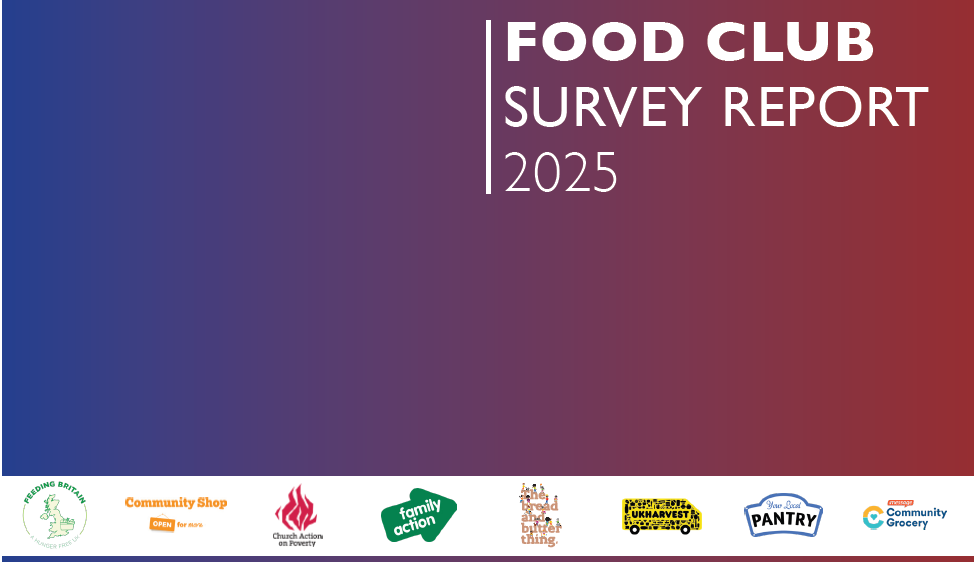
A cover image for the Food Club Survey Report 2025, including that text and several logos, on a blue-red background.
Food Club Survey Report

Pantries: What they say...

James Henderson, Your Local Pantry network coordinator: “Pantries are real places of hope that bring communities together, and enable people to unite and improve each other’s lives together. Reaching one million visits is a testament to the kindness and goodness of all the volunteers, members and supporters across the UK, but also to the effectiveness of the approach.

“Pantries are not a substitute for economic justice – the Government needs to step up to address the scandalous cost of living, and to ensure everyone has an adequate income to live on. But while we press for national change, membership food projects are incredibly transformative. Councils, faith groups or anyone else looking to make a difference would struggle to find a better way to support communities.”

Ed Powell, partner and impact manager at Co-op, a long-standing partner of Your Local Pantry: “Pantries are a progressive step forward to help local people own their access to food, and the powerful membership model has cooperation at its heart. Pantries aren’t just about food – now, more than ever, they show the power of food to bring people from different backgrounds together in community.”

Marie Gilluley, Chair of the SKylight Board in Stockport, where the first Pantries opened in 2013: “It’s remarkable to see how something that began in Stockport has grown into a network serving communities across the UK. Reaching one million visits is an important milestone and a reflection of the steady, dedicated work of our members, volunteers and partners who make each pantry possible.”

Two women sitting side by side, one with a hot drink and one with a pastry

26 in 26: The new social justice poster for churches

How should churches address rural poverty?

Faith In The City: why it still matters, 40 years on

Pantries reach 1 million visits – as new research proves they work

Grief is hard enough: it’s time to improve funeral support

New toolkit: Hosting a regional anti-poverty roundtable

Review: The Perils of Universal Credit

Annual review 2024-25

On poverty and justice: A sermon and prayer for this week

New: The Autumn 2025 Spark newsletter

Prayer, care and action: how Christians should respond to injustice

The amazing 11-year-olds uniting a community through food

Make Them Pay: We’re backing the call for a just tax system

Glory: How I’m striving for change and a better society

Church Action on Poverty Sheffield: 2025 pilgrimage

Empty Plate Project lets local people be heard

We have a new Chief Exec – and we’ll continue to be a catalyst for change!

Are churches losing faith in low-income communities?

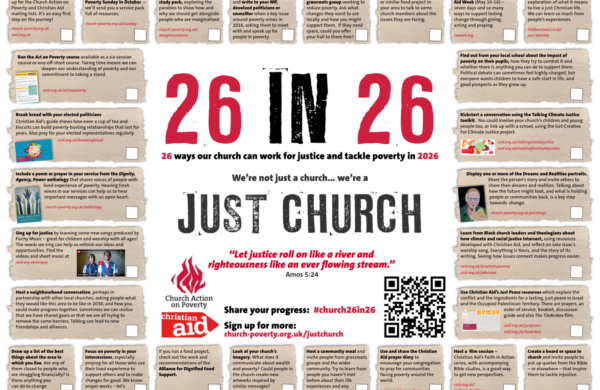
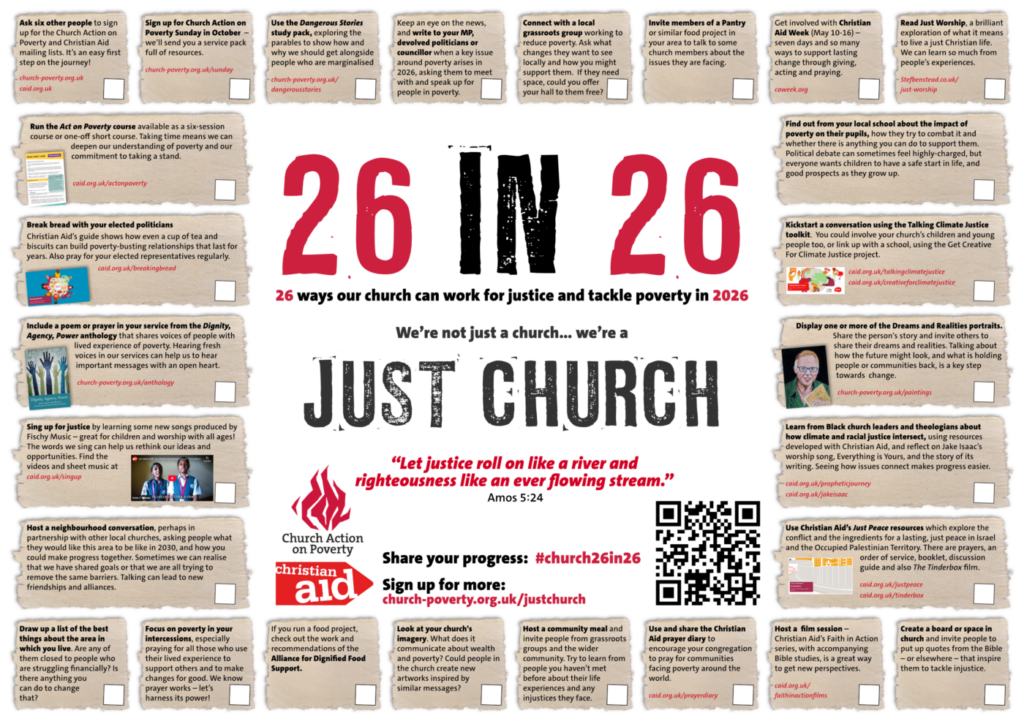
A poster reading "26 in 26", surrounded by 26 text boxes

26 in 26: The new social justice poster for churches

A gentle path through a field in the foreground, with a church steeple in the distance among some trees.

How should churches address rural poverty?

The top section of a book cover, reading Celebrating Forty Years of Faith In The City

Faith In The City: why it still matters, 40 years on

26 in 26: The new social justice poster for churches

Justice is integral to our faith. Church Action on Poverty and Christian Aid have teamed up to produce a new poster that your whole church can use throughout 2026.

The poster contains 26 ideas that you and your church could try in 2026.

Some are very easy, some will take a bit more planning, but all are worthwhile.

We’ve sent this to all churches on our existing mailing lists, but if you’d like a copy then you can download it above. 

Let justice roll on like a river and righteousness like an ever flowing stream.
Amos 5:24

How to use the poster

  1. If you’re printing your own copy, please print in colour in A3 size. If you’ve ordered a posted copy, it will be on its way.
  2. Display it where lots of people will see it – perhaps in your church hall, or near the entrance, or wherever you share teas and coffees! 
  3. Encourage church members and staff to look through the ideas and take responsibility for making some of them happen.
  4. Mark them off as you go
  5. Let us know how you get on! You can email us, or use the hashtag #church26in26.

A call to action

One of the first churches to sign up was Parson Cross Methodist Church at Mt Tabor in Sheffield. 

Pioneer minister Nick Waterfield said: 

"We need to become a Just Church through our actions, and not just talk about it. As Nelson Mandela famously said: 'Do not look the other way; do not hesitate. Recognise that the world is hungry for action, not words'."
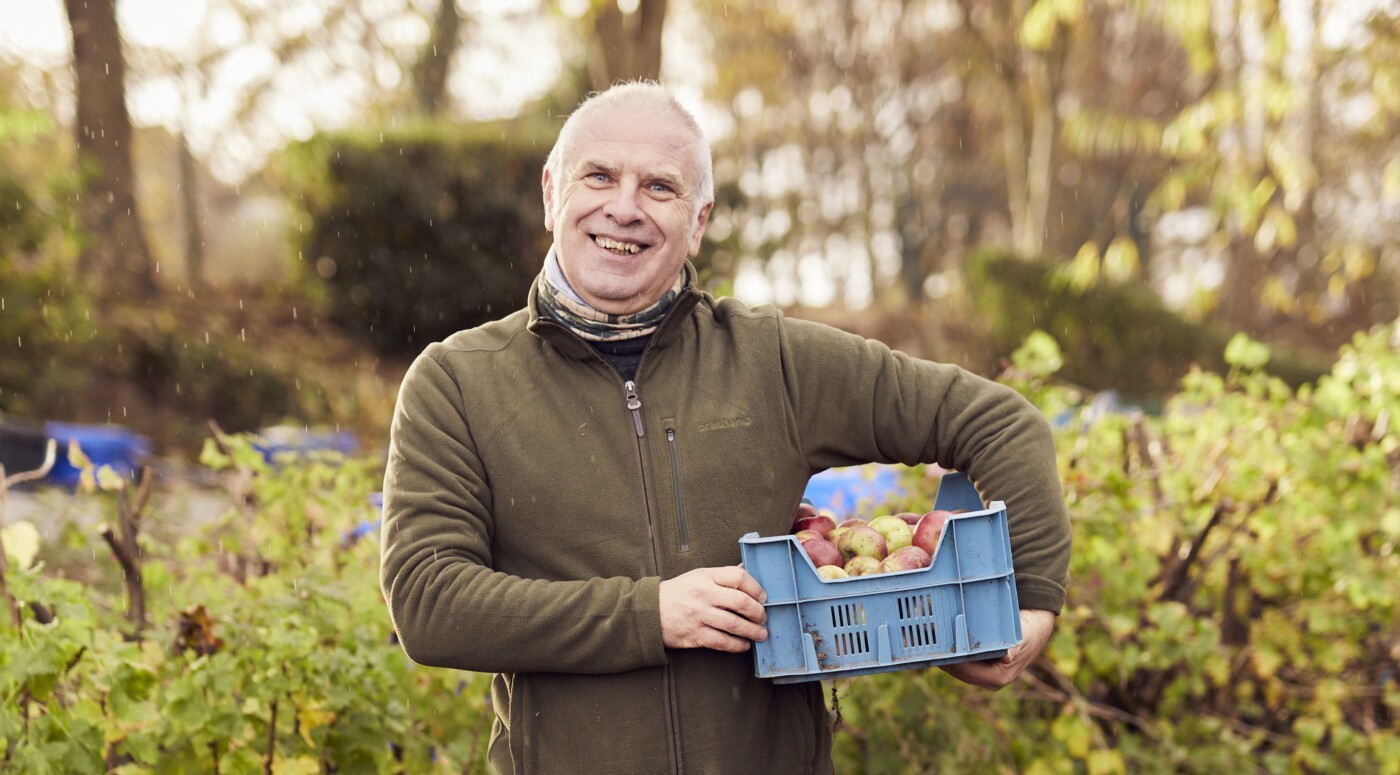
Nick Waterfield outdoors, holding a crate of apples
Nick Waterfield
Pioneer minister, Sheffield

26 in 26: The new social justice poster for churches

How should churches address rural poverty?

Faith In The City: why it still matters, 40 years on

Pantries reach 1 million visits – as new research proves they work

Grief is hard enough: it’s time to improve funeral support

New toolkit: Hosting a regional anti-poverty roundtable

Review: The Perils of Universal Credit

A poster reading "26 in 26", surrounded by 26 text boxes

26 in 26: The new social justice poster for churches

A gentle path through a field in the foreground, with a church steeple in the distance among some trees.

How should churches address rural poverty?

The top section of a book cover, reading Celebrating Forty Years of Faith In The City

Faith In The City: why it still matters, 40 years on

Faith, justice & awesome activists: Niall reflects on his 28 years

Niall Cooper is stepping down after 28 years at Church Action on Poverty. He reflects on some remarkable highlights.

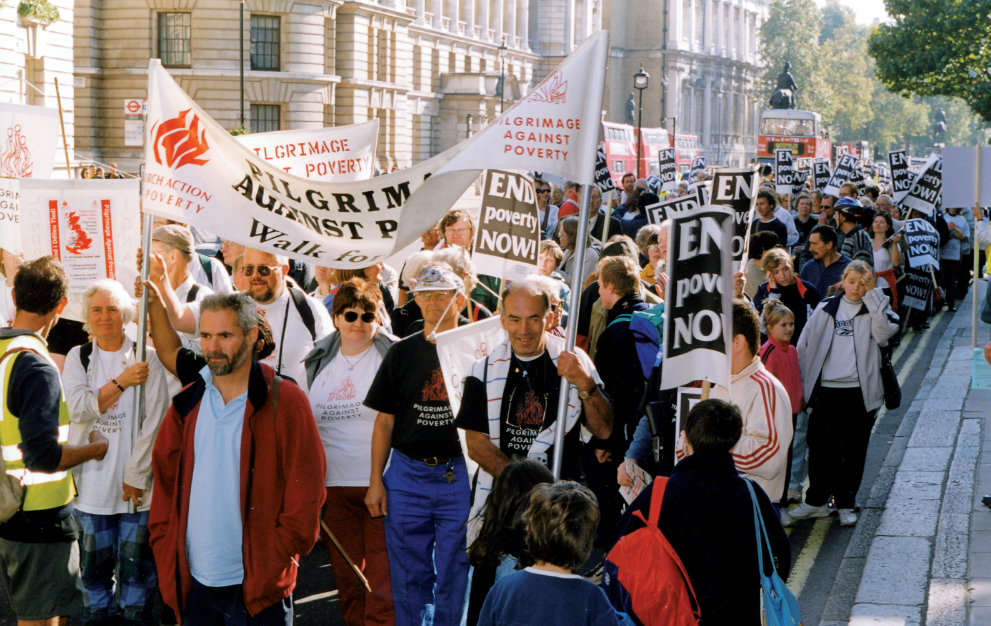
Niall in front of a Pilgrimage Against Poverty banner

How did you first come to be involved in Church Action on Poverty?

Niall: “My university degree had been in politics and religion, and I knew that I wanted to do that work – not just study it, but to do it. My passion was how the churches could make a difference.

“I worked on a project called the Churches National Housing Coalition, in 1991. I had helped set it up and Church Action on Poverty then took it on. I was doing community work in Hulme in Manchester at the time, and housing was the main issue.

“Then a few years later in 1997, the then director Paul Goggins was selected to stand as an MP, and I was appointed as director.”

What are some of your stand-out highlights?

Niall: “I think they come into four categories:

  • the big supporter moments
  • the really big policy wins
  • the moments of impact in local communities
  • and witnessing the inspiring activism of people with lived experience of poverty.

Supporter moments

“The two big supporter moments were the Pilgrimage Against Poverty in 1999, and the Tax Justice bus tour in partnership with Christian Aid in 2013. In 1999, we organised a nine-week pilgrimage from Iona to Westminster. Six people walked the whole way, but thousands of people joined along the route, for a mile or a day or a week.

“It was a significant thing for people to be part of, a once-in-a-lifetime experience. We took a political message and it was amazing – we had a big rally in Trafalgar Square, a service in St Martin-in-the-Fields and the six people who had walked all the way met with the Chancellor, Gordon Brown. 

“Then the Tax Justice Tour was amazing as well – we took a double decker bus around the country, engaging people in conversations. Both of those things really engaged people behind a powerful message, and created space for conversations.”

Above: The Pilgrimage Against Poverty reaches London, in 1999. Below: the Tax Justice Tour bus, in 2013
A traditional red double decker bus, for the tax justice tour

Big wins

“For big wins, I’m going to pick out two. The first was around financial inclusion work, under the New Labour government. We had meetings with a senior Treasury civil servant and we produced a report making the case for investing in affordable credit, as a result of which the Government then invested £120 million into credit unions. 

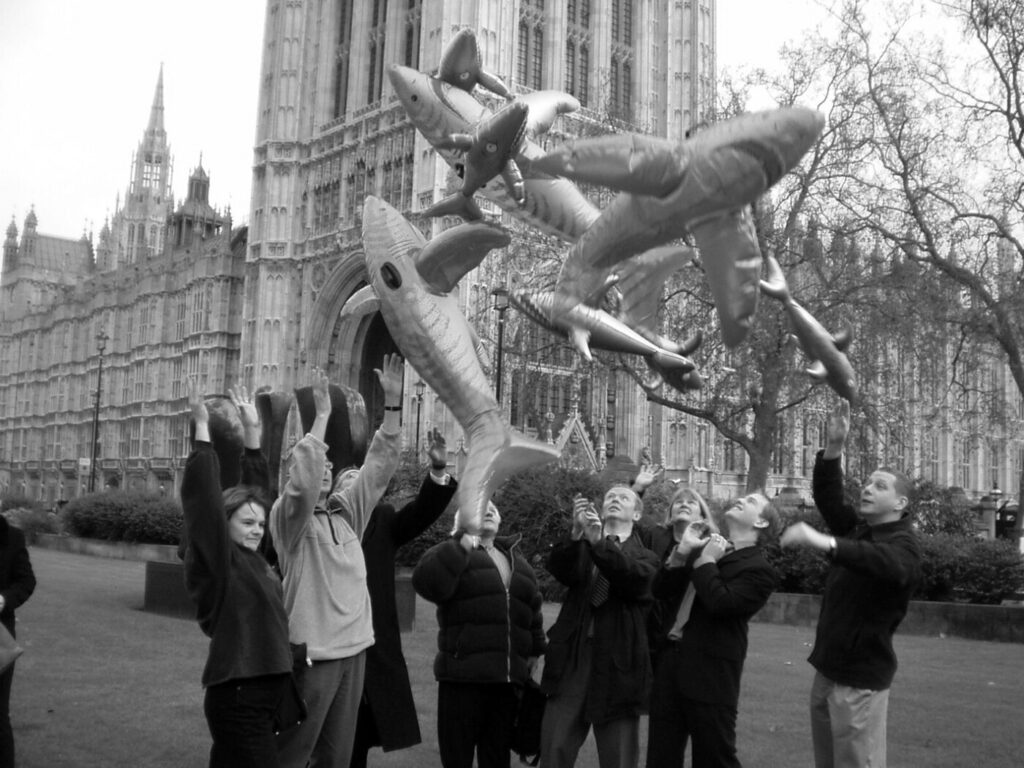
“The other big win was the campaign with Thrive Teesside, around irresponsible high-cost lending. That was led by the women of Thrive over the best part of ten years, with our support.

“The Government was not initially interested, but we built up a coalition with about 80 backbench MPs, and that persuaded the Financial Conduct Authority to properly regulate high-cost lending, and as a result several million pounds in compensation was paid to customers of three main lenders. And because their business model was then broken, that really saw them off.

A black and white photo of inflatable sharks being thrown in the air, outside Parliament

Community impact 

“Along with Oxfam, we introduced Participatory Budgeting to the UK and got the Government to fund us to set up a unit that advised local government. This resulted in over  120 participatory budgeting projects in local communities around the country, each involving hundreds of people – so tens of thousands of people had a direct say in how pots of money were spent in their communities. The Scottish Government then enshrined that approach in law in Scotland.

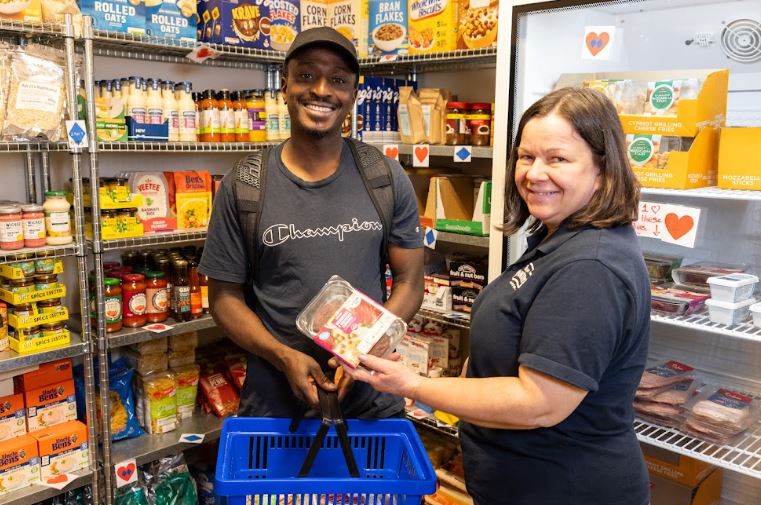
“A second big community impact success has been Your Local Pantry. We took a very local idea and have enabled 120 communities (and counting!) to open Local Pantries, which are bringing people together through food, and enabling great things to happen. The characteristic of both of those areas of work is that they empower communities to have control and dignity and agency.”

A Pantry member holds a basket beside a volunteer; both smile towards the camera

Seeing lived experience campaigners rise up 

“I draw huge inspiration from activists who have refused to give up – people like Wayne Green, Sarah Whitehead and Ashleigh May.

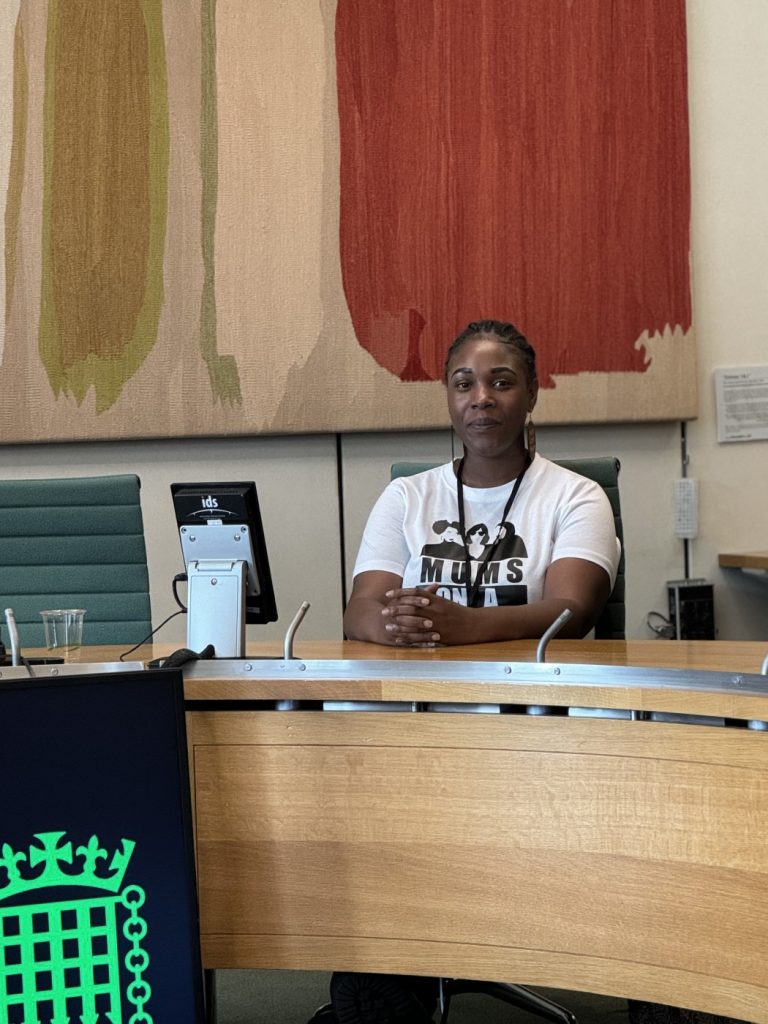
“Wayne spoke at the first National Poverty Hearing in 1996, and is still involved now. Sarah started off as a participant in one local project and now runs Community Pride in Salford, advises Joseph Rowntree Foundation and has trained and supported lots of other people to speak up. Ashleigh [pictured below] was made homeless and moved by her council 200 miles away from her community, but has been determined to speak up and create a space for other people, using her experience as an inspiration for making change.

“There are many other amazing people I could talk about as well!”

Ashleigh sitting in a Parliamentary committee room

What big changes have you seen - and what hasn't changed?

Niall: “People’s belief in political solutions has shifted, and certainly the harshness of the DWP at the moment is more brutal than ever. People who don’t experience poverty do not realise just how punitive and brutal it is. That punitive nature of Government systems has got worse. 

“As the state has pulled away, we’ve seen churches, charities and communities stepping up. Covid was the biggest example of that, where people stepped up. That trend has been for good and ill. Compared with 30 years ago, so many more churches are doing so much more, but there is still a pervasive attitude in places that it’s about tackling poverty one person at a time, individualising the problem and the solutions. 

“One of the things that has endured is the nature of poverty. As Wayne Green said in the 1990s, “poverty is a battle of invisibility and being blamed for society’s problems”. The context has changed, but that is as true now as it was then.

“Another area where we have made strides is in the growing recognition of the importance of prioritising lived experience voices. The Dear Prime Minister letters last year exemplified that – we were able to gather 12 to 15 people, well supported by six or seven organisations around the country, and that would not have happened ten or even five years ago.”

A row of people sitting behind a curving table, with a Let's End Poverty banner behind

What is your parting message to UK churches - and what are your own plans once you step down?

Niall: “The big task for churches is helping build a powerful movement in which people do feel they have agency, dignity and power, and in which they have enough allies to push back and say ‘enough; we are not going to take this any more’. Churches should invest in that, rather than sticking plaster solutions.

“As for my next steps… Well, in my 60s, I’ve started fell-running, and have just done the Yorkshire Three Peaks race, and I’ll also have some time for seeing family and travelling.

“I’m going to have a bit of a break and reflect on what I have learnt, but I am not stepping away from the anti-poverty movement. This is still what I am passionate about, and I still want to keep in touch with some of the amazing people I have met, but I also want to find out what’s the next challenge I can do.”

26 in 26: The new social justice poster for churches

How should churches address rural poverty?

Faith In The City: why it still matters, 40 years on

Pantries reach 1 million visits – as new research proves they work

Grief is hard enough: it’s time to improve funeral support

New toolkit: Hosting a regional anti-poverty roundtable

Review: The Perils of Universal Credit

Annual review 2024-25

On poverty and justice: A sermon and prayer for this week

New: The Autumn 2025 Spark newsletter

Prayer, care and action: how Christians should respond to injustice

The amazing 11-year-olds uniting a community through food

Make Them Pay: We’re backing the call for a just tax system

Glory: How I’m striving for change and a better society

Church Action on Poverty Sheffield: 2025 pilgrimage

Empty Plate Project lets local people be heard

We have a new Chief Exec – and we’ll continue to be a catalyst for change!

Are churches losing faith in low-income communities?

“The cuts are deeply immoral and should be opposed by all Christians”

SPARK newsletter summer 2025

Let’s End Poverty: what comes next?

Faith, justice & awesome activists: Niall reflects on his 28 years

In a queue, and newly homeless, I realised: this is where change begins

Legacies: invest in a future without poverty

Sharing Power to Shape Mission

Activists work to shape policies of the future

A poster reading "26 in 26", surrounded by 26 text boxes

26 in 26: The new social justice poster for churches

A gentle path through a field in the foreground, with a church steeple in the distance among some trees.

How should churches address rural poverty?

The top section of a book cover, reading Celebrating Forty Years of Faith In The City

Faith In The City: why it still matters, 40 years on

Briefing: New Government data further undermines its cuts to UK’s vital lifelines

The Government's own statistics show that disabled people are already three times as likely to be living in food insecurity

Church Action on Poverty briefing

9 April 2025

Newly published Government data has shown the severe scale of poverty and food insecurity in the UK, and shows once again how disastrous it would be to further cut support for disabled people, as the Government proposes to do.

The newest release of the Family Resources Survey shows that one in ten UK households was living in food insecurity in 2023/24.

That equates to around 2.8 million households where people do not have consistent access to the good food they need – an increase of 600,000 in four years.

The picture is even more shocking for groups already hit hardest by Britain’s neglected housing and social security systems. The data shows that:

  • In households where there are no disabled adults, food insecurity is 6%, but in households where there is one or more disabled adults it soars to 16%.
  • Among homeowners (with or without a mortgage), food insecurity is only 3%, but in the private rented sector it is 17%, and in the social rented sector it is 31%.

The data covers the year 2023/24, so reflects the position when the current Government took office.

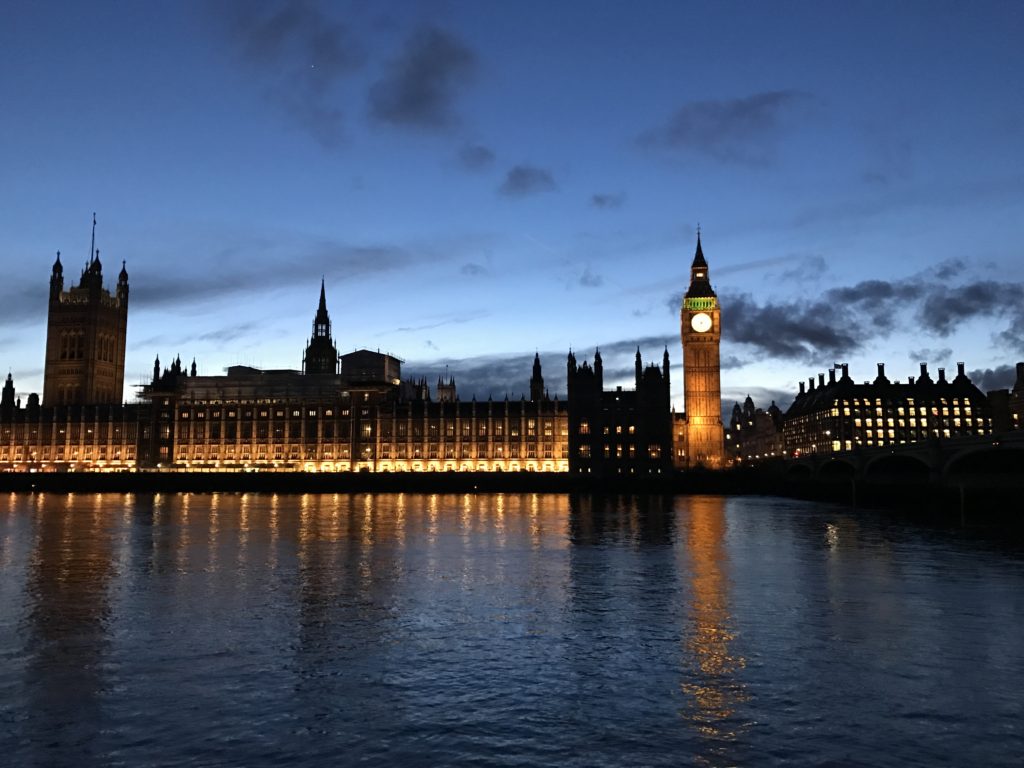
An evening photo of the House of Commons, from across the Thames

Food insecurity: background and context

The fact that this data is even measured is thanks to the tenacious efforts of food justice campaigners, including through the End Hunger UK campaign.

In 2020/21, the Government added a series of food-based questions to the annual Family Resources Survey, allowing the scale of the issue to be shown clearly for the first time.

The first data release, covering 2019/20, showed that 8% of households were in food insecurity. That number reduced in the subsequent two years, at the peak of the Covid-19 pandemic, but has since increased sharply as vital lifelines have been withdrawn.

Church Action on Poverty comment

“Millions of families in the UK worry about whether they will have enough food, and whether they can afford a nutritious and varied diet. It is a shameful indictment on successive Governments that such poverty is continuing in such a wealthy country.

“The direction of travel should be obvious to politicians: As a starting point, we need to repair our shared social security system so that everyone has enough to live on.

“There should be no cuts to social security, which is already woefully inadequate. It is immoral for the Government to raid the country’s poorest households, just so it can stick to its self-imposed financial tactics. Disabled activists like Mary, Stef and Sydnie say the impact of yet more cuts to disability support would be devastating and terrifying

In recent years, the cost of living scandal has swept more and more people into poverty, very few people’s wages have kept pace with inflation and housing has remained prohibitively unaffordable for most people.

“Against that context, Westminster politicians have been steadily dismantling Britain’s cherished social security system instead of bolstering it. This data shows that an extra 600,000 households have been made food insecure in the past four years. 

“The Government response must be to reverse those damaging trends, not to accelerate them. Repeated polls show that the public are unhappy about levels of poverty and inequality in Britain, and want action. 

“Ending poverty needs to be a national priority. Instead this Government is singling out disabled people for swingeing cuts, while allowing far richer people to bear little or no burden.”

Food insecurity: links and data

Say no to the immoral cuts

Church Action on Poverty is supporting the widespread national calls to oppose the immoral cuts to disability support.

The threatened cuts to Britain’s shared social security system are immoral, deeply harmful to some of the country’s poorest people, and are based on misleading spin.

Disabled activists Stef, Mary and Sydnie, who work with and advise Church Action on Poverty, say the further dismantling of crucial welfare support threatens to impoverish them, and flies in the face of Government promises and thorough evidence. Read more of their story and ask your MP to help oppose the cuts here.

26 in 26: The new social justice poster for churches

How should churches address rural poverty?

Faith In The City: why it still matters, 40 years on

Pantries reach 1 million visits – as new research proves they work

Grief is hard enough: it’s time to improve funeral support

New toolkit: Hosting a regional anti-poverty roundtable

Review: The Perils of Universal Credit

Annual review 2024-25

On poverty and justice: A sermon and prayer for this week

New: The Autumn 2025 Spark newsletter

Prayer, care and action: how Christians should respond to injustice

The amazing 11-year-olds uniting a community through food

A poster reading "26 in 26", surrounded by 26 text boxes

26 in 26: The new social justice poster for churches

A gentle path through a field in the foreground, with a church steeple in the distance among some trees.

How should churches address rural poverty?

The top section of a book cover, reading Celebrating Forty Years of Faith In The City

Faith In The City: why it still matters, 40 years on

Say no to these immoral cuts, built on weasel words and spin

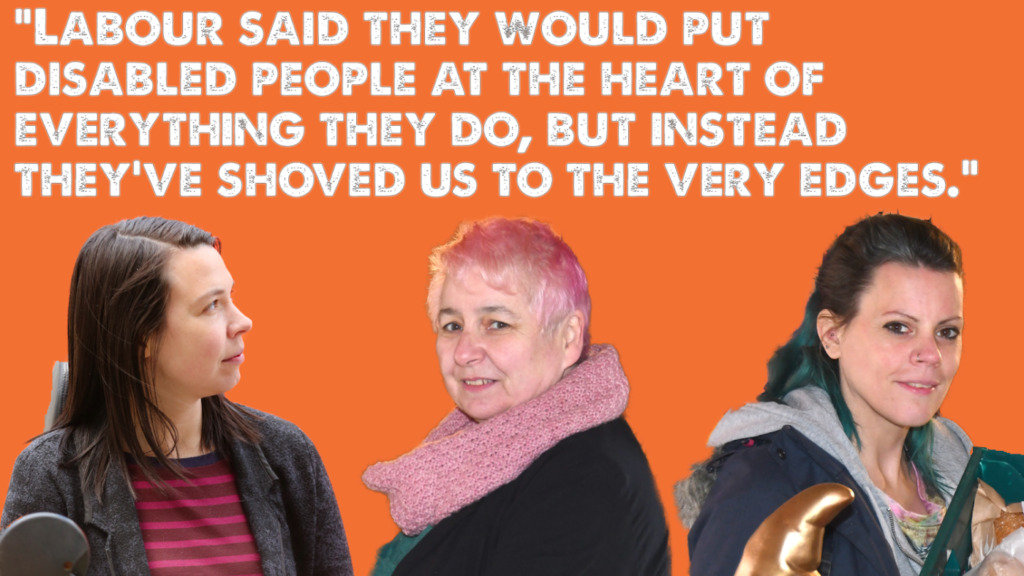
Labour said they would put disabled people at the heart of everything they do. But instead they have shoved us to the very edges.

The proposed cuts to Britain’s social security system are immoral, are deeply harmful to some of the country’s poorest people, and are based on misleading spin.

Disabled activists who work with and advise Church Action on Poverty say the further dismantling of crucial welfare support threatens to impoverish them, and flies in the face of Government promises and thorough evidence.

Stef Benstead, Sydnie Corley and Mary Passeri are all involved in the Speaking Truth to Power programme and other campaigns, and have joined the growing calls all over the country for the threatened cuts to be cancelled.

Cut-outs of Stef, Mary and Sydnie. Text above says: "Labour said they would put disabled people at the heart of everything they do. But instead they have shoved us to the very edges."

No to cuts: Now honour the promise

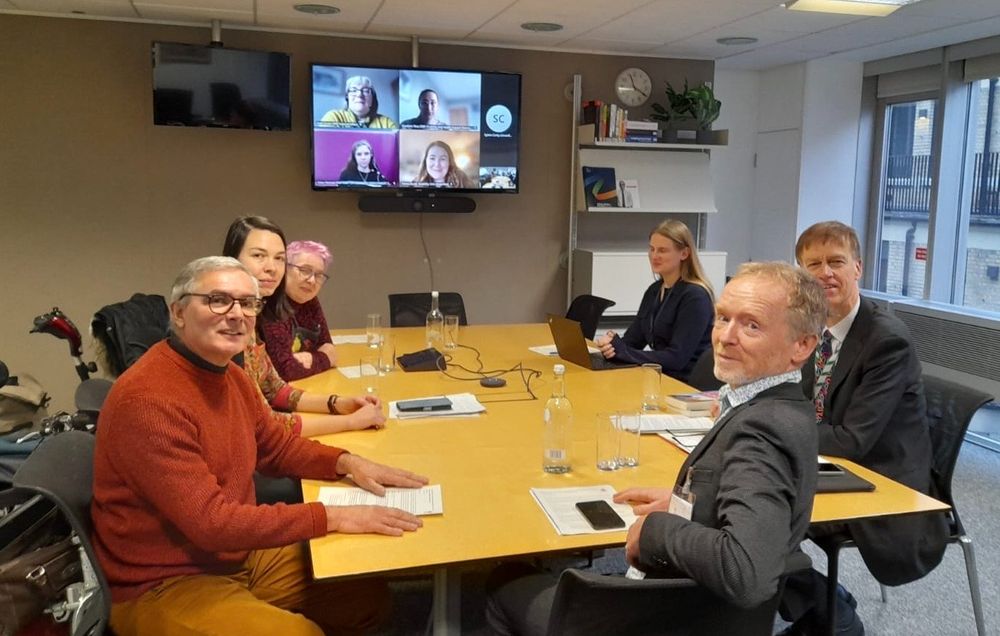
In December, Stef, Sydnie, Mary and others met the minister for disability, Sir Stephen Timms MP, who had said that disabled people would be at the heart of the Government’s actions.

Church Action on Poverty is urging Stephen Timms to honour that pledge, and today we are asking supporters to ask their MPs to make similar calls. 

Stef: They're deliberately misleading the public to buy support for cuts

Stef said: “Labour said they would put disabled people at the heart of everything they do, but instead they’ve shoved us to the very edges. They’re using a lot of spin and weasel words, but it is worse than empty rhetoric. It is deliberately misleading the public in order to buy support for immoral, harmful cuts.

“It really is a bogus consultation. The things they aren’t consulting on, and the assumptions made behind the things that they are consulting on, make the results a foregone conclusion. The cuts will happen, and they’re not interested in anything other than pretending to care about the people affected.

“Anyone can launch a consultation and say that it will be ‘close’. But to launch a consultation when you’ve already stated that there is no consultation on the ‘four-point’ criterion, and you’ve already decided how much money it will save, is not an honest consultation.”

Sydnie: We know the DWP does not score people correctly

Sydnie highlighted that in recent years, hundreds of thousands of people who were initially refused PIP were wrongly rejected, and had the refusal overturned at appeal, showing that the Government has a terrible track record at assessing people’s health and disability.

She says: “The DWP does not understand people’s conditions. Their ‘professionals’ are not qualified in many disabilities or in who can receive what payment, and what jobs people are capable of. The waiting list for PIP is too long.

“Too many people have to appeal where they were originally awarded hardly any points, then achieve the proper high amount in each category via the appeal. This waiting time is even longer and one that is degrading and not accessible to all, and this whole process is too much of a strain on people’s physical and mental health.

“How on earth are they going to reassess everyone, with what cost, as there are not enough staff as it is. We know the DWP does not score people correctly. They are unqualified for this job and under too much strain to cope.

“How on earth are they going to reassess everyone, with what cost, as there are not enough staff as it is. We know the DWP do not score people correctly. They are unqualified for this job and under too much strain to cope.

Mary: These cuts apply pressure not to live any more

Mary said she was terrified that the changes were coming in at the same time as the assisted dying legislation. She said: “The benefits system should be there as a safety net. I totally agree it should not be an alternative way of living, But it needs to be a stronger net, with fewer tears to fall through!”

“Now this is happening and the assisted dying laws are coming in as well. You can foresee a system where they will say they’ll give me benefits for another five years, and that’s it – and then in the context of assisted dying, see what pressure that puts on people not to live any more!”

Speaking Truth to Power panelists meet with minister Stephen Timms
Mary (back left), Sydnie (remotely) and Stef (middle left) were part of a group that met Stephen Timms (far right) in December. Now they're urging him to be true to his word.

Stef dissects the Government's spin on cuts

Stef said much of the Government’s statement this week was hollow spin. 

She says: “You can be as harsh a government as you like and still pretend to the masses that you are nice, really, because you support the ‘greatest needs’ – just not the ‘also great but we’ve decided we can’t afford them’ needs.”

“The fact is that all the evidence shows that people assessed as unfit for work – whether required to prepare for work or not – are demonstrably not fit for work. Consequently any cuts to support for these people means that Labour is not protecting those who cannot work. And they are spinning this by claiming that we are people who are of non-genuine need.

“For example, I don’t receive the Daily Living component of PIP. Whilst I think this is wrong (I can only shower once a week and have to pay an assistant to cook for me, as well as doing my cleaning, tidying, washing up, and laundry which aren’t assessed by PIP), it means that I don’t qualify for the Health Element of Universal Credit under Labour’s proposed system.

“Yet, I’ve been unable to work since 2011. Various attempts to work have led to suicidal depression as I struggle with the demands of working not even eight hours a week.”

She also said the Government’s claim that the work capability assessment was binary was untrue, as it already has three possible outcomes: fit for work; unfit for work but fit to prepare for work; unfit either to work or prepare for work. And she criticised the suggestion that the number of PIP awards was not sustainable.

“How does that work? Is Liz Kendall saying that I am not sustainable? Too many people have long-term needs so the problem is that we’re unsustainable for each other? Taking PIP away from people who depend on it does not help people who depend upon it. It does not make PIP more sustainable long-term for them; rather, their lives have been made less sustainable.”

The system should not push people into poverty

Sydnie said: “We should be able to entrust our Government to ensure there is a system that is fair, prosperous, and sustainable, which is looking forward and grows with the modern world, that has empathy and deeper understanding of how to support everyone who is living here.

“We should all have a future, to feel worth and again, to not feel a burden on society, and to not be judged unfairly for this. Everyone has some right to self actualisation, to have dignity, to be heard and listened to, and also have a legal right to not be pushed into poverty, to have a good standard of living environmentally and mentally.

“People who live in Britain have fought for human rights, equal rights, racism, gender rights, equality, a fair social system, disabled rights and far far more. Is money more important than people’s lives and living experience? The Government has control and yet deems us as nothing more than a waste of money, draining the public’s purse.”

Sydnie said most jobs did not reflect the flexibility that disabled people would inevitably need. 

“How on earth can the Government create jobs that are flexible, inclusive, and offering reasonable adjustment – such as time off at short notice with no repercussions, full support and at minimum wage and above?

“Will the Government make working places hire staff at their cost, where their insurance has to be increased, with new risk assessments, buying specialist equipment, having another member of staff to stand by at any time to replace their shift?

“And the other measures won’t make people better: covering child care costs won’t cure people; reducing benefits won’t cure people; voluntary work won’t cure people; adding more support with CVs, interviews or short basic courses won’t cure people – and most people know how to do these things. Disabled people are not uneducated as the Government seems to believe. 

“Can’t the Government comprehend that some people are simply unable to work, but need to have the same rights as everyone, and to stop cuts to supportive programs, outreach centres, social workers, and accessibility to all.”

Mary: They understand us but they're doing it anyway!

Mary says: “Will job training or loss of money take away my son’s autism? Will it cure his health issues? Will it cure cerebral palsy and learning disabilities? It will not change any of that!

“I would love to work, to be back doing research work and group work, but how can I when some days I cannot even remember the names of people I am with? If I was employed, the employer would also need to employ someone else too, to cover when I was too ill to work. Small businesses can’t afford to employ people who can’t work regularly, and big businesses are not going to.

“I feel totally and utterly let down, because when the Conservatives were putting forward cuts and the UN was saying what they were doing was unlawful and should be stopped, Labour were jumping all over them trying to say it was all wrong. 

“Now they’re in power, not only have they ignored that, but they are being worse! People say the Government needs to talk to people to understand, but that’s not enough – they have talked to people, they do understand, they’re speaking to people – but they’re doing this anyway! It’s all window dressing.”

“I already get less Universal Credit than my rent, so it’s essential I get PIP, or I would not have anything to eat! I get the standard rate of Universal Credit, as I’m unable to work. At the moment I’m not expected to work, or look for work. My son Adriano is on the special higher rate, and he’s not expected to work.

“I will be in their target group, because it’s people with severe aches and pains they will target. Most of the jobs available in York are coffee shop jobs – how could I work in a coffee shop, having to be on my feet and flexible. I can have good days, but last time I did something exertive, when I went to London for a meeting, I was in bed for nearly a week!

“For me, you can probably get four good hours out of me, but in that time I’d need to get washed and dressed, eat and get to where I would need to be. That could take three hours already… who’s going to give me a job for an hour?!”

“And are we saying people’s only reason for being is to go to work, because then when some people finish work, we’re in so much pain and cannot look after our family or do anything in life. Are they really saying that’s okay? As a disabled person, don’t I deserve a work-life balance like anyone else?

“I know it’s hard to arrange a really fair system, but punishing people who cannot work will not make them work. And for people who would like to work but are disabled, support needs to go to employers to enable that. Telling people to work when no employer would touch them is not going to help.

“After we met Stephen Timms, we were at least tentatively hopeful that there may be some real exchange. The Government’s actions would quash that hope. 

“Why can’t we have a Government that is prepared to give real protections and quality of life to disabled people? If the Government could bring themselves to stop scapegoating and instead invest in bettering the situation for disabled people, then perhaps there would be less pressure on social and health services.

“This investment could begin with education. Children with disabilities have been facing cuts to essential services that would allow them to benefit from an education thus refusing them any real aspiration and ambition.”

Stef, Sydnie and Mary are members of the Speaking Truth to Power programme coordinated by Church Action on Poverty.

Stef is also the author of Second Class Citizens: The Treatment of Disabled People in Austerity Britain

26 in 26: The new social justice poster for churches

How should churches address rural poverty?

Faith In The City: why it still matters, 40 years on

Pantries reach 1 million visits – as new research proves they work

Grief is hard enough: it’s time to improve funeral support

New toolkit: Hosting a regional anti-poverty roundtable

Review: The Perils of Universal Credit

Annual review 2024-25

On poverty and justice: A sermon and prayer for this week

New: The Autumn 2025 Spark newsletter

Prayer, care and action: how Christians should respond to injustice

The amazing 11-year-olds uniting a community through food

Make Them Pay: We’re backing the call for a just tax system

Glory: How I’m striving for change and a better society

Church Action on Poverty Sheffield: 2025 pilgrimage

Empty Plate Project lets local people be heard

We have a new Chief Exec – and we’ll continue to be a catalyst for change!

Are churches losing faith in low-income communities?

“The cuts are deeply immoral and should be opposed by all Christians”

SPARK newsletter summer 2025

Let’s End Poverty: what comes next?

Faith, justice & awesome activists: Niall reflects on his 28 years

In a queue, and newly homeless, I realised: this is where change begins

Legacies: invest in a future without poverty

Sharing Power to Shape Mission

A poster reading "26 in 26", surrounded by 26 text boxes

26 in 26: The new social justice poster for churches

A gentle path through a field in the foreground, with a church steeple in the distance among some trees.

How should churches address rural poverty?

The top section of a book cover, reading Celebrating Forty Years of Faith In The City

Faith In The City: why it still matters, 40 years on

78 pics: Pantry members get creative to end poverty

From mosaics to murals, pots to paintings, Pantry members have been creating stunning art pieces this year

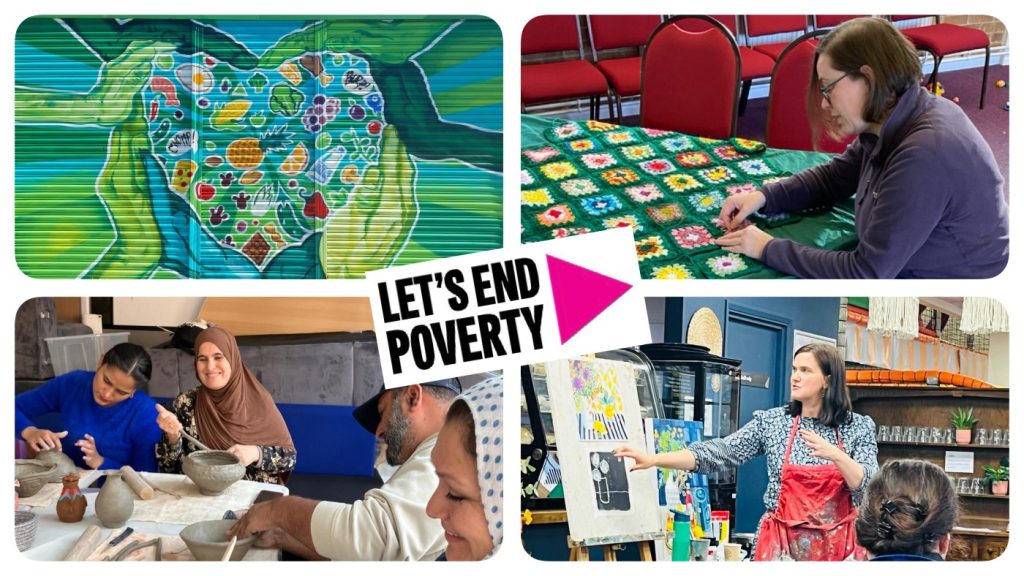
The Let's End Poverty text logo, on a collage of four images of people doing craft or art.

Dozens of people around the UK have been taking part in creative arts projects, alongside the Let’s End Poverty campaign.

Earlier this year, grants were provided to ten Your Local Pantries, to enable them to organise projects that would bring members together and amplify their voice.

Several of the projects have now been completed. The variety and creativity have been spectacular! We’ve seen crochet and cards; pots and portraits, mosaics, murals and more. 

Check out the photos below, via the Your Local Pantry facebook page:

Let's End Poverty art projects

Creations have included:

  • Members designed a mural for the shutters of Greenhouse Pantry in Edinburgh
  • In Reading, members crocheted a woollen Christmas tree, which was then fitted to a wooden frame and illuminated outside the Pantry.
  • In Birmingham, members have been learning pottery, and creating their own pots and vases decorated with their personal stories.
  • Members in Macclesfield have been working on a mosaic, and eight accompanying pieces of art.
  • In Kingston, London, members produced personal portraits exploring life’s challenges and their hopes, and also made Christmas cards.
  • In Kilcooley in Northern Ireland, members took part in community workshops and came up with the idea of a mural of bears, representing the strength and resilience of the community.   

What members said

“When I first joined, I felt excited and curious to learn something new, and I loved the warm, welcoming atmosphere of the sessions. I feel that these workshops have truly helped me express myself through art and given me a space to connect with others who share the same interest. It’s made me feel like I have a clearer voice and presence.”

……

“It felt creative and it was lovely to get out of the house for a couple of hours without worrying how I would afford it…. I jumped at the chance to socialise and not be just “mum” for a night. I feel that more hobbies should be available to all on low incomes. It gives you something to look forward to when things are getting on top.”

……

“The soul searching was a surprise, I wasn’t prepared for the emotional work. But in the end it was an amazing experience. It was out of my comfort zone, but I loved it.”

……

“My pot represents a mandala pattern: some nature and trees, and my house. I want to have every part of my culture, my village and my city on the pot.”

……

“I am so proud of our cards. I can’t believe I have designed a card that will be sold!”

……

“It was an opportunity for introspection and thinking about our pasts and future – sometimes uncomfortable but best not left totally unscrutinised… I’ve never been so proud of something I’ve created before.”

……

“I’m proud and delighted to be able to help facilitate the group. It gives great pleasure to use creativity to build confidence and hope in humanity. ‘Altrusim’ (a key point summed up so well by one of our young members) of the whole team, means we can appreciate the smooth running of the Pantry each week. The mosaic helps foster appreciation for not only the wealth of food and daily items so needed but that we are all together and dependent on one another for support. I’m grateful for the opportunity to do something creative in such a meaningful way. Thankyou!”

……

“I shop regularly at the Pantry. It’s an absolute lifeline to me. Being part of the mural project was such a rewarding experience. The idea of using bears to symbolise the weight of the cost-of-living crisis and the fact it’s a family of bears really got me, cause they’re strong and resilient, just like us trying to get by.

“Every time I see the mural, it brightens my day and reminds me of the strength of the community. It was lovely to watch the kids helping to paint – it was adorable seeing their little creative contributions come to life. It gave the project such a family vibe, which is exactly what this place feels like: a Pantry family.” 

26 in 26: The new social justice poster for churches

How should churches address rural poverty?

Faith In The City: why it still matters, 40 years on

Pantries reach 1 million visits – as new research proves they work

Grief is hard enough: it’s time to improve funeral support

New toolkit: Hosting a regional anti-poverty roundtable

Review: The Perils of Universal Credit

Annual review 2024-25

On poverty and justice: A sermon and prayer for this week

New: The Autumn 2025 Spark newsletter

Prayer, care and action: how Christians should respond to injustice

The amazing 11-year-olds uniting a community through food

Make Them Pay: We’re backing the call for a just tax system

Glory: How I’m striving for change and a better society

A poster reading "26 in 26", surrounded by 26 text boxes

26 in 26: The new social justice poster for churches

A gentle path through a field in the foreground, with a church steeple in the distance among some trees.

How should churches address rural poverty?

The top section of a book cover, reading Celebrating Forty Years of Faith In The City

Faith In The City: why it still matters, 40 years on

Doing food together: An invitation to all churches

Churches urged to open more Pantries

Bishop says community food approach “goes to the heart of the Christian faith"

Churches across the UK are being urged to consider opening food Pantries, as a way to strengthen their neighbourhoods and build local hope.

The Your Local Pantry network has 121 Pantries across the UK, but knows churches are ideally placed to host more and is inviting church leaders to commit to opening a Pantry in 2025.

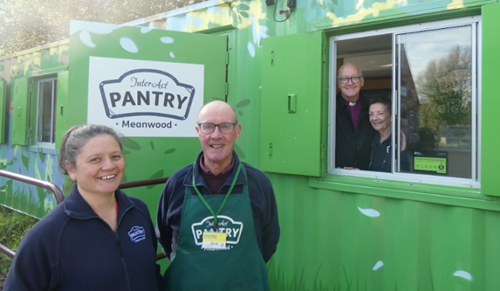
Last week, the Rt Revd Nick Baines, Bishop of Leeds, visited InterAct Pantry in Meanwood, north Leeds, and talked with members and volunteers about the impact it has locally. The Pantry is run by a charity made up of Anglican, URC, Baptist and Methodist Churches.

Bishop encourages churches to get involved

Bishop Nick said: “What’s really impressive is that we recognise that food isn’t just for eating – we commune around food. So whether people are collecting food or eating food together, it’s a social event. It goes to the heart of the Christian faith as well, this is what we do all the time.

“I would encourage churches to consider how they might be engaged and involved in this. We need to remember, Jesus said we will be judged by whether we visit the sick, feed the hungry, give drink to those who are thirsty and so on. You can!”

Your Local Pantry’s recent Places Of Hope report found that Pantries had saved members £10.5 million in the past two years, and showed that they were bringing a wide range of community benefits, such as improved health, reduced isolation, and enhanced access to other opportunities and services.

Church Pantries reach almost 60,000 people

The Rt Revd Nick Baines, Bishop of Leeds, looks out of the InterAct Pantry window, with volunteers in the foreground

Church Action on Poverty, which coordinates the network, is now able to provide a breakdown of the figures for church-based Pantries.

Of the 121 Pantries in the network, 73 (60%) are hosted by or supported by churches or Christian charities. The first Pantry in a church opened five years ago this November, in Birmingham, and since then church-backed Pantries have been visited 362,300 times, supporting 59,800 people in 22,700 households. (If all Pantries are counted, church and non-church, those figures rise to 691,700 visits, supporting 121,800 people in 44,100 households).

Pantries are a perfect fit for pantries

James Henderson, network development coordinator for Church Action on Poverty, says: “Pantries are all about dignity, choice and hope. They are a perfect fit for churches who want to cement their role in their community, and who want to help make change happen.

“Many churches have spaces that lend themself to Pantries, but also an abundance of compassion and potential volunteers. If any church is wondering how to use food as a gateway to hope, we’d love to hear from you.”

The Bishop of Leeds chats to a volunteer, inside InterAct Pantry

Pantries bring vast community benefits

The entire Your Local Pantry network has saved members £5.76m in the past year, and £10.5m in the past two years – but the benefits go far deeper. Research has shown that 83% of Your Local Pantry members say it has been good for their mental health; 74% feel more connected to their local community; 66% have made new friends; and 63% now eat more fresh fruit and vegetables. Pantries also have an average of 15-20 volunteers each,

Pantries are also increasingly about ongoing social transformation, with many members this year becoming involved in local democracy, social campaigns, and art projects.

Anyone interested in opening a Your Local Pantry should email info@yourlocalpantry.co.uk

One church’s story

North End Baptist Church in Portsmouth ran a food bank which had supported around 10,000 people in the five years up to 2020, and when the pandemic struck the level of local need soared. Covid changed the way the team worked, but it also prompted some reflection. Was this the right approach, or was there a better way?

Jo Green, one of the Pantry managers, says: “We spoke to schools and other organisations. They were telling us they had families who needed help but who would not go to a food bank because of the stigma. It made us wonder what we could do. 

“Our minister, Tracey, knew someone who ran a Pantry and we looked at a couple, and decided that becoming a Pantry was the way forward. We closed our food bank at the start of April 2021, and three weeks later we opened as a Pantry. The stigma has certainly reduced. We have a lot of families now and we are finding that people really value it more because they are paying towards it.

“We want to reach people in the area and build relationships. With a Pantry, people come back every week and start opening up and you hear how much it means to people. We are a church so we can direct people in the church to the Pantry, and also let Pantry members know about other things like the toddler groups.”

The Your Local Pantry logo

26 in 26: The new social justice poster for churches

How should churches address rural poverty?

Faith In The City: why it still matters, 40 years on

Pantries reach 1 million visits – as new research proves they work

Grief is hard enough: it’s time to improve funeral support

New toolkit: Hosting a regional anti-poverty roundtable

Review: The Perils of Universal Credit

Annual review 2024-25

On poverty and justice: A sermon and prayer for this week

New: The Autumn 2025 Spark newsletter

Prayer, care and action: how Christians should respond to injustice

The amazing 11-year-olds uniting a community through food

Make Them Pay: We’re backing the call for a just tax system

Glory: How I’m striving for change and a better society

Church Action on Poverty Sheffield: 2025 pilgrimage

Empty Plate Project lets local people be heard

We have a new Chief Exec – and we’ll continue to be a catalyst for change!

A poster reading "26 in 26", surrounded by 26 text boxes

26 in 26: The new social justice poster for churches

A gentle path through a field in the foreground, with a church steeple in the distance among some trees.

How should churches address rural poverty?

The top section of a book cover, reading Celebrating Forty Years of Faith In The City

Faith In The City: why it still matters, 40 years on

Merseyside Pantries reach big milestone

The Merseyside Your Local Pantry conference was a big success

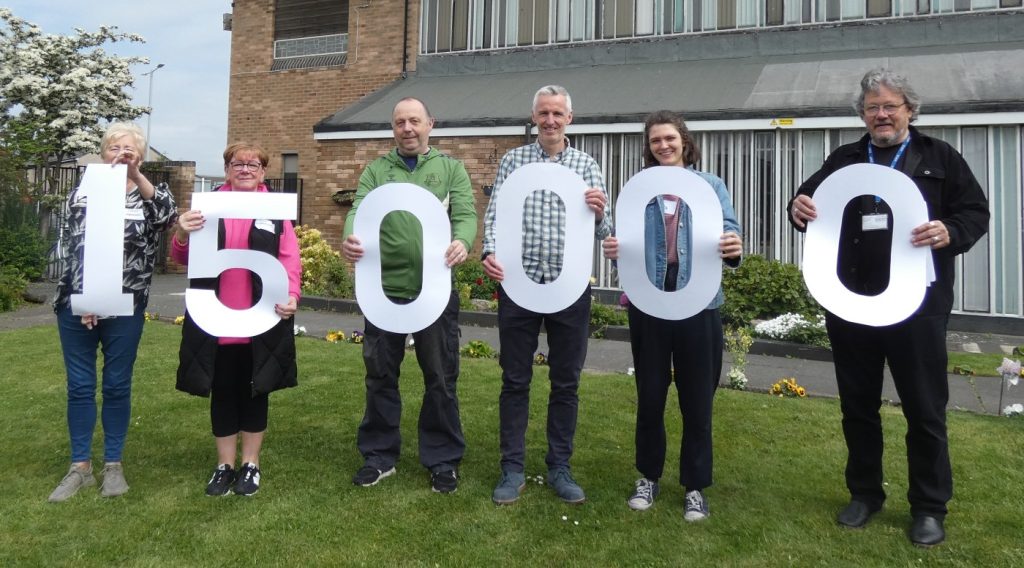
Merseyside’s network of neighbourhood Pantries have now been visited 150,000 times, and can be springboards for renewed hope and strength across the region.

Dozens of Your Local Pantry coordinators, volunteers, members and supporters from across Merseyside gathered last week to celebrate their communities and share ideas, and this week they reached the 150,000 milestone.

6 people holding cut-out numbers, reading 150,000

The scale of the Merseyside Pantry reach

Merseyside has more Pantries than any other region in the UK, with 26 across Liverpool, South Sefton and St Helens. The 150,000 visits have been from 11,286 members. When members’ families are included, the Pantries have supported 27,745 people.

The regional conference was held at St Leonard’s Church in Bootle last week.

People took part in workshops, heard about national campaigns and initiatives they could join, shared practical tips for making Pantries work as well as possible, and watched this powerful film about the Pantry in Kensington Fields, about local people’s efforts to strengthen and safeguard the community.

"Hotbeds of social justice innovation"

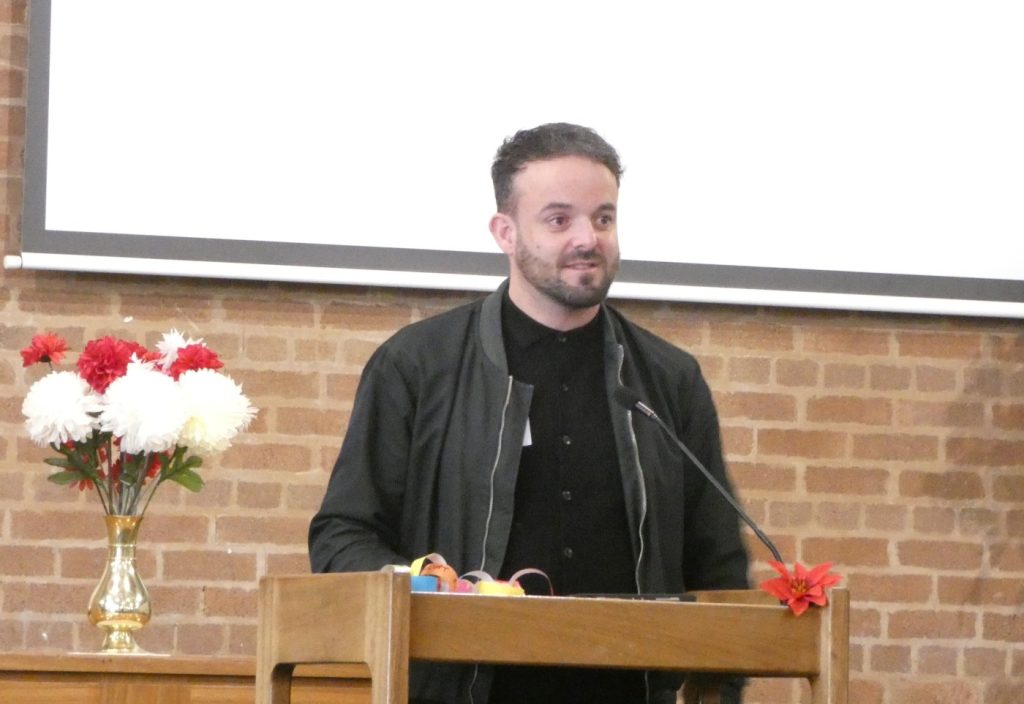
Rich Jones, speaking at the Merseyside Your Local Pantry conference in Bootle

Rich Jones, chief executive of St Andrew’s Community Network, which supports many Pantries in the north of Liverpool, said at the conference:

“The beautiful thing about Pantries is that they have the potential to be hotbeds of social justice innovation. They are places where connection and relationship is cultivated. It’s a joy to see some of the additional initiatives that have been borne out of the Pantry experience, building communities rooted in dignity, choice, and hope.”

He added: “Poverty is mostly caused by structural and systemic issues, and at the moment it is exacerbated by rising living costs… The UK welfare system also makes it difficult for people struggling to get a decent income.”

Pulling together - and pulling apart the chains

Chris Shelley pulls apart a paper chain at the Your Local Pantry conference in Bootle, Merseyside

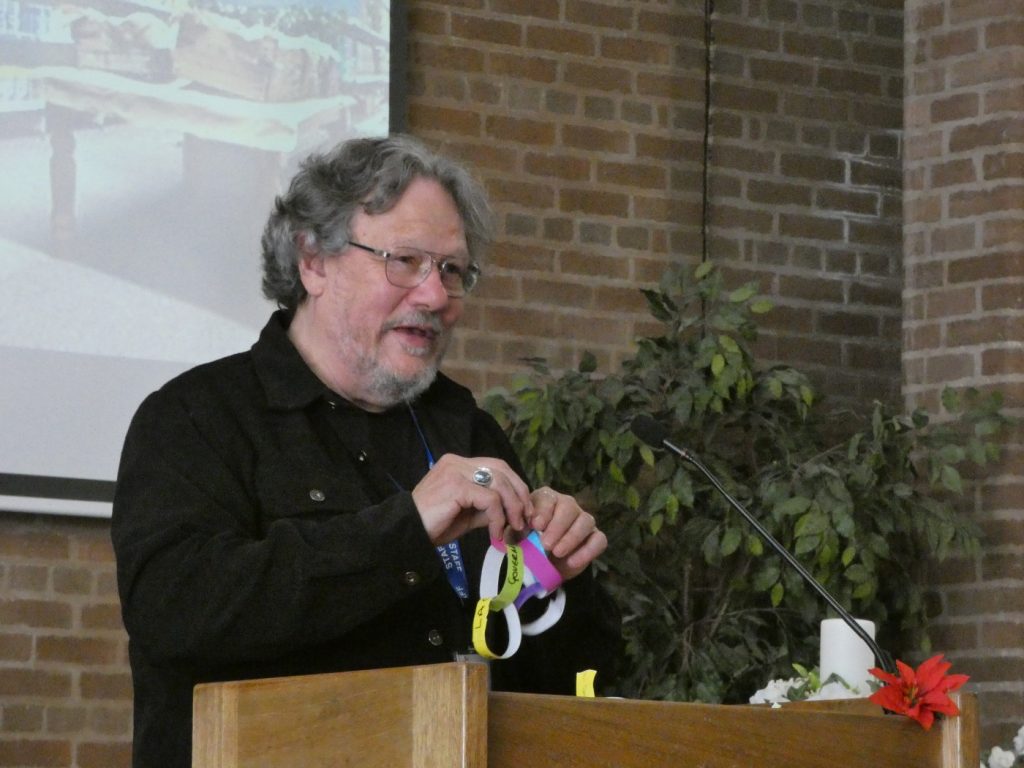
Chris Shelley, Your Local Pantry development worker for Merseyside, said Bootle had been poorly treated by decision-makers for many years, and was now an area with a lot of poverty, but he said:

“There are a lot of people who love this place and care about Bootle, and want to live here. If a community pulls together, it can do things, and that’s what Pantries are all about.” 

Chris had invited people arriving at the conference to write down a symptom or cause of poverty. These were formed into a paper chain, and at the end of the event Chris symbolically tore apart the chain, encouraging people to loosen poverty’s grip on people and communities.  

Thank you to everyone at Merseyside Pantries

James Henderson, national Your Local Pantry coordinator, said afterwards:

“It’s less than four and a half years since the first Pantry opened in Merseyside, and the growth and impact has been incredible. To reach nearly 30,000 people and 150,000 visits is remarkable, and I want to say a huge thank you to every member, volunteer and partner organisation who has been a part of this. 

“Merseyside’s Pantries are dynamic, welcoming, dignified places that offer choice and renew hope. 

“We know poverty in the UK is a national disgrace, and the cost of living scandal is pushing many more households into deep hardship. Whoever forms the next Government needs to make ending poverty a priority.

“At the same time, we praise and recognise the fantastic work of so many people working to reclaim dignity, choice and hope together in the meantime.”  

26 in 26: The new social justice poster for churches

How should churches address rural poverty?

Faith In The City: why it still matters, 40 years on

Pantries reach 1 million visits – as new research proves they work

Grief is hard enough: it’s time to improve funeral support

New toolkit: Hosting a regional anti-poverty roundtable

Review: The Perils of Universal Credit

Annual review 2024-25

On poverty and justice: A sermon and prayer for this week

New: The Autumn 2025 Spark newsletter

Prayer, care and action: how Christians should respond to injustice

The amazing 11-year-olds uniting a community through food

Make Them Pay: We’re backing the call for a just tax system

A poster reading "26 in 26", surrounded by 26 text boxes

26 in 26: The new social justice poster for churches

A gentle path through a field in the foreground, with a church steeple in the distance among some trees.

How should churches address rural poverty?

The top section of a book cover, reading Celebrating Forty Years of Faith In The City

Faith In The City: why it still matters, 40 years on

Dreams & Realities: welcome to an incredible exhibition

Learn the story of Dreams & Realities, and the stories behind it

A powerful new art exhibition has been launched, telling the stories and aspirations of people in poverty.

Dreams & Realities is on display at St Mary’s Church in Sheffield, and will then go on tour as part of the Let’s End Poverty campaign.

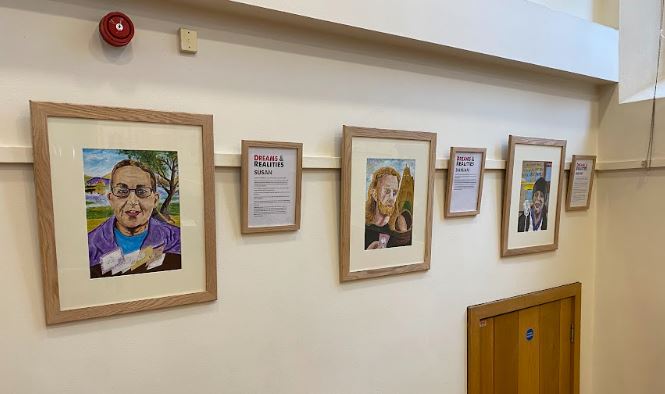
Dreams & Realities of people's lives

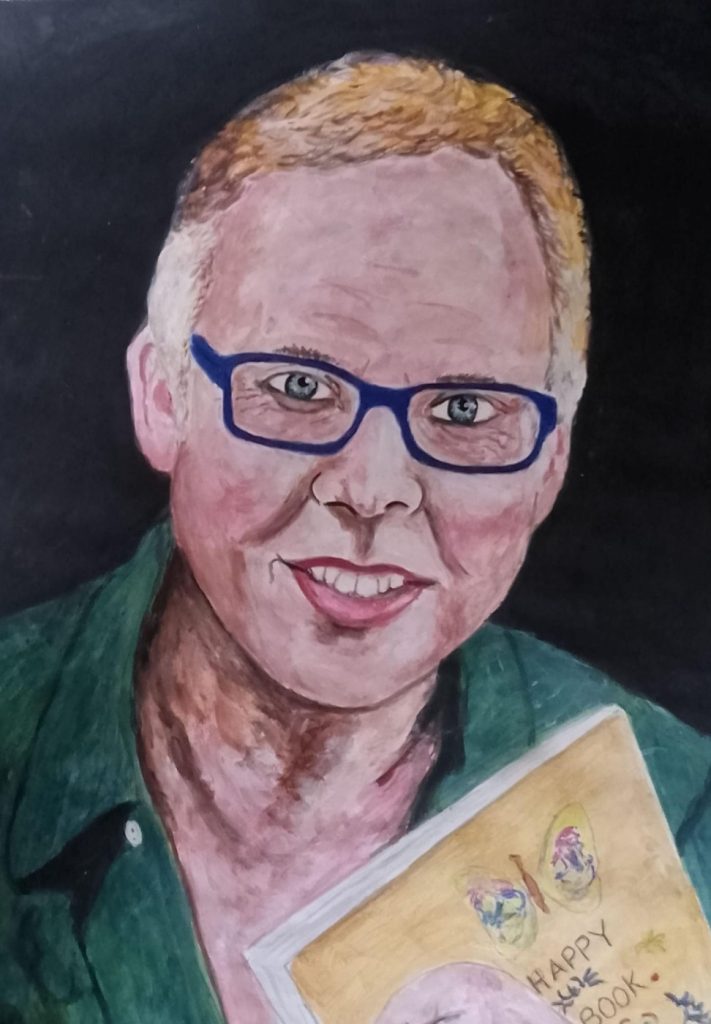
Stephen Martin, a local artist, has painted acrylic portraits of nine people living in poverty in Sheffield, including himself.

Each picture shows the person, something that depicts their economic reality, and something that represents the dreams and ambitions they would pursue if they were not held back by poverty and unjust systems.

The project has been coordinated by Yo Tozer-Loft, who runs a community choir at St Mary’s, with support from Church Action on Poverty.

Three of the portraits on the wall

Yo says:

“I really hope the paintings show the reality for a lot of people in this country. There are still a lot of people constrained to live on the front line of poverty and I really hope this project shows their humanity by their dreams. All humans have dreams and as humans together we should enable each other’s dreams, and Governments should enable the health and the dreams of the people they govern.”

————

Stephen's story

Stephen’s self-portrait includes a wellbeing journal, which has helped him with his mental health.

The background is black, as the electrical circuits in Stephen’s home blew more than ten years ago, so he has lived without electricity ever since. His income is only £340 a month.

Stephen says:

“Just being on benefits, I feel the pinch come the end of the month. It’s a struggle just to get by day by day, so I hope the message we’re putting over in this exhibition about poverty does have an effect in the General Election campaign and it does become a major issue within the election.”
————

Dreams & Realities: The launch

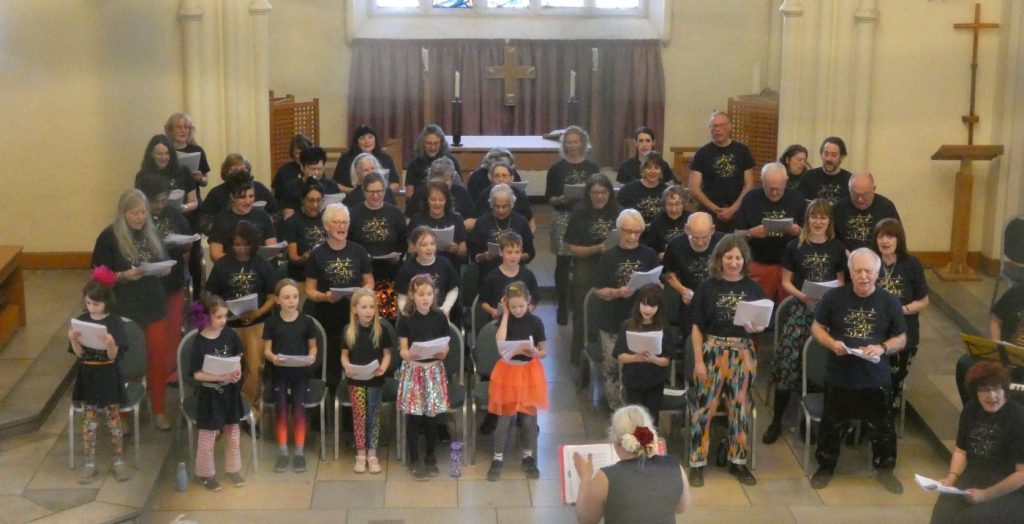
A shot from upstairs of the choir singing in St Mary's Bramall Lane

The exhibition was launched at St Mary’s in March, at a special celebratory concert, which also included the choir singing Disney songs.

The initial response to the paintings was incredible, with many people deeply moved by the stories, and encouraged to get involved in the Let’s End Poverty campaign.

The people behind the paintings

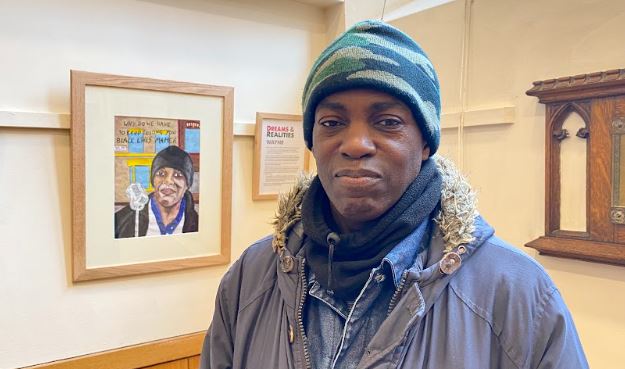
Wayne stands in front of his portrait
Wayne in front of his portrait at the Dreams & Realities launch.

The stories in the exhibition are deep and diverse.

For instance, Wayne, who is homeless and who supports people hit hard by the cost of living scandal, dreams of empowering others to overcome issues such as racial injustice and homeless.

Liudmyla moved to Sheffield as a refugee from Ukraine, and the school where she had taught was bombed in the war. Her dream is to gain English teaching qualifications so she can resume teaching, but the great uncertainty around the war and her right to stay in England are represented in the painting by a crystal ball.

  • More detail on all the individual stories is included in the exhibition.
  • Dreams & Realities will be on display at St Mary’s Church, Bramall Lane, Sheffield, until the end of April. See the church website for opening hours.
  • The exhibition will then tour nationally in support of the Let’s End Poverty campaign. 

26 in 26: The new social justice poster for churches

How should churches address rural poverty?

Faith In The City: why it still matters, 40 years on

Pantries reach 1 million visits – as new research proves they work

Grief is hard enough: it’s time to improve funeral support

New toolkit: Hosting a regional anti-poverty roundtable

Review: The Perils of Universal Credit

Annual review 2024-25

On poverty and justice: A sermon and prayer for this week

New: The Autumn 2025 Spark newsletter

Prayer, care and action: how Christians should respond to injustice

The amazing 11-year-olds uniting a community through food

Make Them Pay: We’re backing the call for a just tax system

Glory: How I’m striving for change and a better society

Church Action on Poverty Sheffield: 2025 pilgrimage

A poster reading "26 in 26", surrounded by 26 text boxes

26 in 26: The new social justice poster for churches

A gentle path through a field in the foreground, with a church steeple in the distance among some trees.

How should churches address rural poverty?

The top section of a book cover, reading Celebrating Forty Years of Faith In The City

Faith In The City: why it still matters, 40 years on

This outrageous, counter-productive Budget marginalises people with least

This is Church Action on Poverty’s statement on the 2024 Budget. It includes the views of our expert advisors with direct current experience of poverty.

Church Action on Poverty's logo, alongside the Houses of Parliament

The 2024 Budget further punishes and marginalises people on the lowest incomes, and is outrageous and counter-productive.

That’s the message from social justice campaigners with Church Action on Poverty.

Recent Budgets have rarely provided adequate support or good news for people on low incomes, despite polling showing that 88% of the British public think more should be done to tackle poverty.

Further cuts to public services will harm communities and people who are most likely to need public systems such as health services, libraries, social housing, public transport, and children’s and youth centres.

Calculations by Church Action on Poverty indicate a two-parent family on £60,000 a year will be about £3,100 better off a year as a result of the Budget and Autumn statement, including cuts to National Insurance and the increases to child benefit given only to higher income households, whereas the childcare assistant or teaching assistant charged with looking after their children on a starting salary of £14.500 will be a grand total of £80 better off. 

How can this be right? 

And someone unable to work due to disability or caring responsibilities will not be better off by a single penny. How can this be right?

Our advisers, all of whom have direct current experience of poverty, have called for a more just tax system, action to fix the UK’s broken housing system; and investment in a long-term future for everyone rather than short-term tweaks.

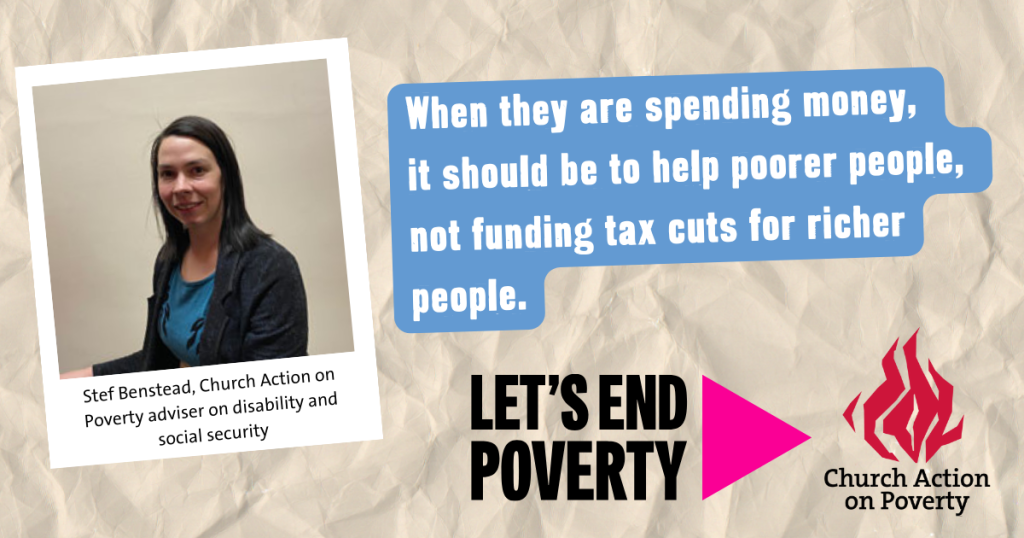
A headshot of Stef Benstead ,with a quote: "When they are spending money, it should be to help poorer people, not funding tax cuts for richer people."

Stef Benstead said:

“I would want them to be increasing taxes on the wealthiest people so they can fund social care and health care properly. When they are spending money, it should be to help poorer people, not funding tax cuts for richer people.

“The Chancellor’s supporters say countries with low taxes grow fastest, but that’s only in the short term, because you then have a bust. IMF research has shown that the more equal countries grow fastest in the long term because they do not have that bust afterwards.

“We need to look at what makes for steady long-term growth. The answer is to reduce inequality. Data shows we could be much more equal – more equal than Scandinavian countries – and still improve growth. We need to look at what makes for long-term growth, and the way to do that is taxing the very richest, because they currently take too much for themselves.

“It’s not a matter of punishing wealth, but of deterring rich people from over-paying themselves excessively while their staff are struggling on low pay.”
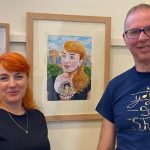
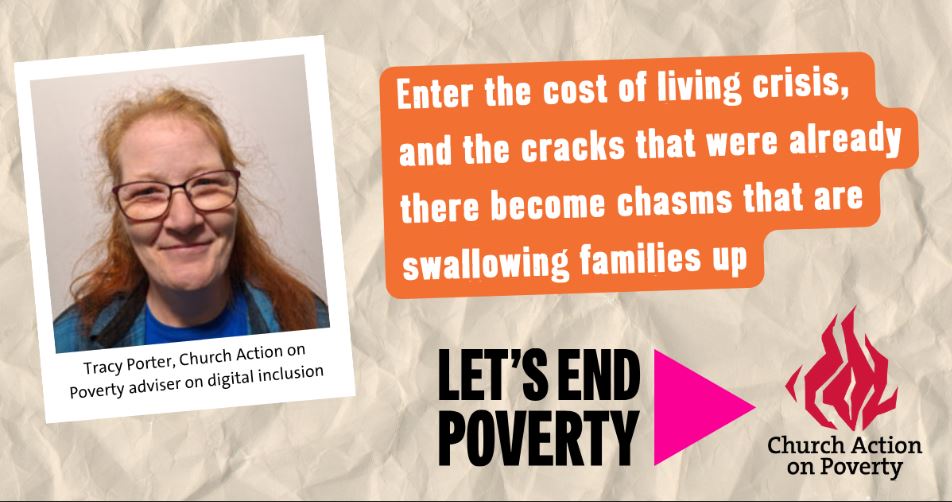
Tracy Porter said:

“We need to commit to meaningful co-production policies with people who have experienced the impact of previous policies.

“I would also like to see more done to increase digital inclusion. So many people have not got the same access, and that means their opportunities are limited, whereas if they had equal access then people could achieve more.

“It affects young people at school and also older people, who maybe are told to use technology to do tasks and send things. It’s not just about having the technology, but also knowing how to use it.

“It is estimated that it costs around £120,000 to raise a child to the age of 18. £120,000 is a lot of money for any household, but if you find yourself unfortunate enough to be at the bottom of the economic scale it becomes even more difficult to provide the basic essentials for that child to flourish.

“A lot of families, in reality, have very few choices. Some families have a disability, learning difficulty or mental health issue, some have to cope with all of these things as well as raising a child to the best of their abilities.

“Without fair access, children can quickly fall behind and the gap between what they and their peers can achieve grows ever wider. Enter the cost of living crisis and the cracks that were already there, become chasms that are swallowing families up.”

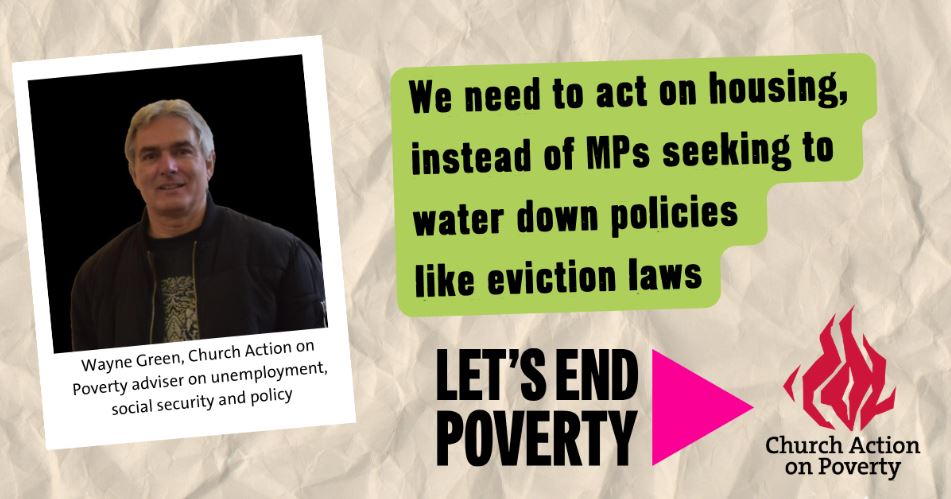
A headshot of Wayne Green, with the quote: "We need to act on housing, instead of MPs seeking to water down policies like evictions laws."

Wayne Green said:

“A wealth tax is needed. We need an asset tax. Once you earn more than £250,000 you pay less tax as you can afford to invest in assets and shares. If you had something like a 3 percentage point tax increase on offshore wealth, it could pay for so much – it could pay much of our national debt off.

“The very wealthiest people have millions or billions. There is an imbalance – we should be taxing the super rich and investing in this country long-term.”

“We need a better form of community tax. It does not work properly. And we need to act on housing, instead of MPs seeking to water down policies like eviction laws.”

Wayne had said he would be worried about the ending of the Household Support Fund, which he had said would be outrageous. In the Budget, it was extended by only six months.

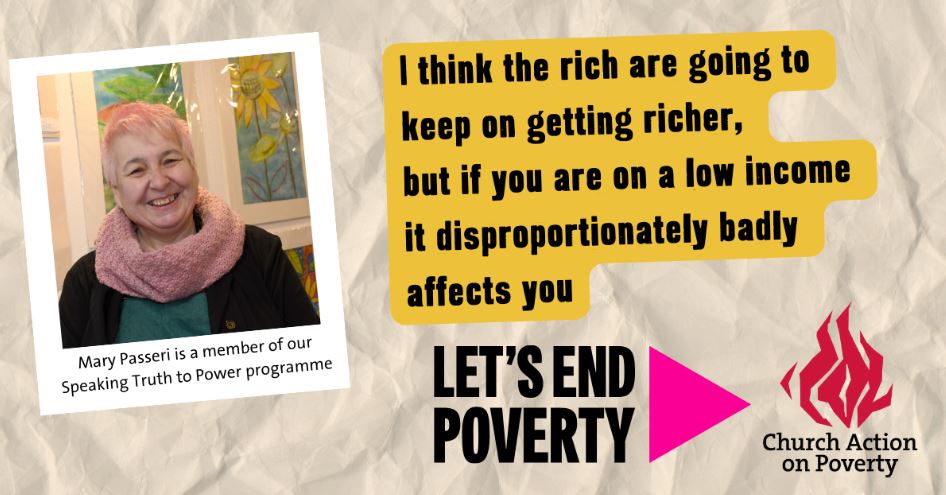
A headshot of Mary Passeri with a quote reading: "I think the rich are going to keep on getting richer, but if you are on a low income it disproportionately badly affects you."

Mary Passeri said:

“I think the rich are going to keep on getting richer, but if you are on a low income it disproportionately badly affects you.”

Alisha Barton said:

“I think it will make no positive difference to me, and cutting National Insurance inherently means a cut to public services.”

Sydnie Corley said:

“What needs to really change is the difference in income when you try to get back into work, or into more work. I am part time and if I go over the income thresholds, I lose everything else suddenly.”

Contributors to this article are member of Church Action on Poverty’s Speaking Truth To Power programe.

  • Stef Benstead is advisor on disability and social security, and also the author of Second Class Citizens: The Treatment of Disabled People in Austerity Britain.
  • Tracy Porter is a trustee and digital inclusion advisor.
  • Wayne Green is advisor on unemployment, social security and policy.

26 in 26: The new social justice poster for churches

How should churches address rural poverty?

Faith In The City: why it still matters, 40 years on

Pantries reach 1 million visits – as new research proves they work

Grief is hard enough: it’s time to improve funeral support

New toolkit: Hosting a regional anti-poverty roundtable

Review: The Perils of Universal Credit

Annual review 2024-25

On poverty and justice: A sermon and prayer for this week

New: The Autumn 2025 Spark newsletter

Prayer, care and action: how Christians should respond to injustice

The amazing 11-year-olds uniting a community through food

Make Them Pay: We’re backing the call for a just tax system

Glory: How I’m striving for change and a better society

Church Action on Poverty Sheffield: 2025 pilgrimage

Empty Plate Project lets local people be heard

A poster reading "26 in 26", surrounded by 26 text boxes

26 in 26: The new social justice poster for churches

A gentle path through a field in the foreground, with a church steeple in the distance among some trees.

How should churches address rural poverty?

The top section of a book cover, reading Celebrating Forty Years of Faith In The City

Faith In The City: why it still matters, 40 years on